
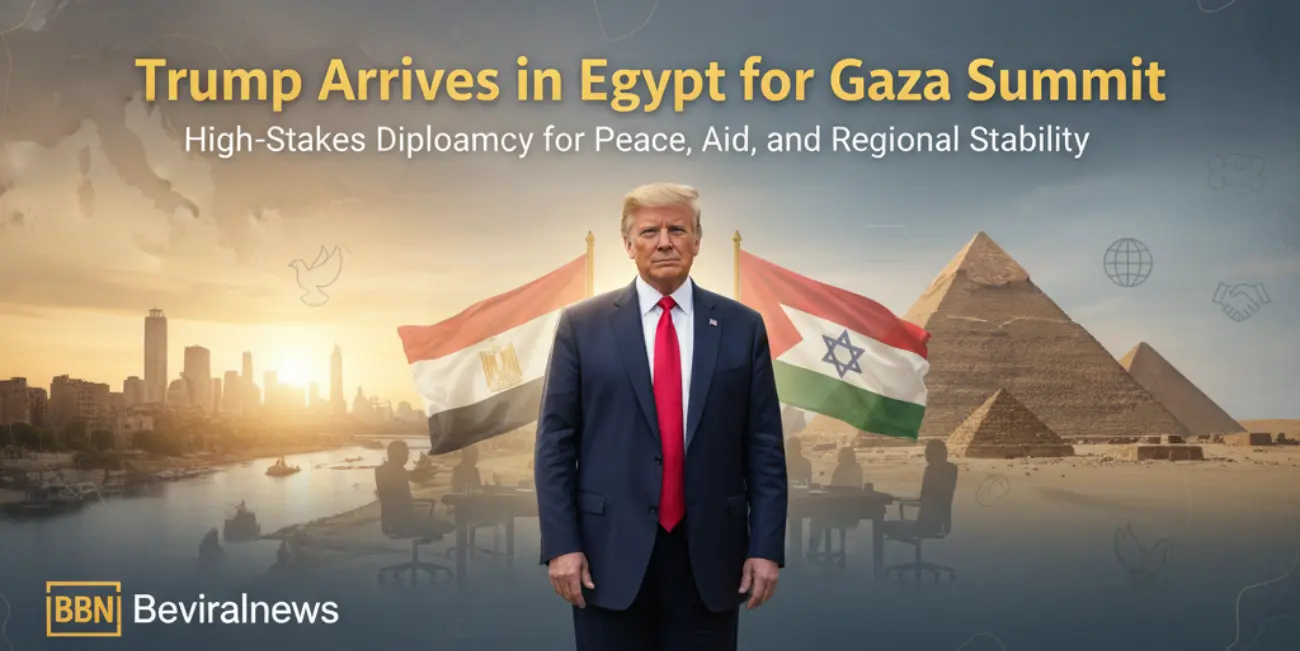
Donald Trump’s arrival in Egypt for a high-stakes Gaza summit marks a pivotal moment in Middle East diplomacy. Centered in Cairo, the talks aim to forge agreements on a ceasefire, humanitarian aid corridors, and reconstruction in Gaza—potentially reshaping the region’s geopolitical future.
Why the Summit Matters
The Cairo Gaza summit is more than another diplomatic gathering—it could determine the fate of millions living amid decades of conflict. Egypt, long a mediator between Israel and Palestinian factions, provides the ideal venue: geographically central, politically connected, and diplomatically experienced.
A Brief Historical Context
The Gaza Strip, home to over two million Palestinians, has endured repeated wars, blockades, and humanitarian crises. During his 2017–2021 presidency, Trump pursued the Abraham Accords, normalizing relations between Israel and several Arab nations. While those agreements advanced regional diplomacy, critics said they ignored the Palestinian question—the conflict’s central issue. Now, Trump returns as a private citizen but influential figure, signaling renewed focus on Gaza’s plight.
Inside the Cairo Summit
Key Participants
The summit gathers a diverse set of stakeholders:
- U.S. delegation – including Trump and possibly current officials
- Egyptian government – host and chief mediator
- Palestinian Authority and Hamas representatives
- Israeli envoys
- Observers from Saudi Arabia, Jordan, Qatar, and the UAE
- United Nations officials – overseeing humanitarian provisions
Each brings distinct priorities. Egyptian President Abdel Fattah el-Sisi’s government seeks to cement Egypt’s role as the indispensable peace broker.
Core Issues on the Table
- Ceasefire terms – Ensuring all parties commit to halting violence, with credible monitoring and enforcement mechanisms.
- Humanitarian access – Opening secure corridors for aid while addressing Israeli security concerns.
- Reconstruction – Coordinating funding and oversight to rebuild Gaza’s infrastructure.
- Governance and long-term stability – Exploring political reconciliation among Palestinian factions and future administrative frameworks for Gaza.
Trump’s Unique Role
His Diplomatic Leverage
Trump retains close relationships with regional leaders, including Netanyahu, el-Sisi, and Saudi Crown Prince Mohammed bin Salman. As an outsider, he can propose unconventional ideas without official constraints. His transactional negotiation style, focused on mutual benefits, could yield breakthroughs traditional diplomacy has failed to achieve.
The Challenges
Yet his involvement is controversial. Palestinians recall Trump’s recognition of Jerusalem as Israel’s capital and his 2020 “Peace to Prosperity” plan, viewed as biased toward Israel. His current unofficial status also limits his ability to secure binding commitments, requiring coordination with Washington to ensure continuity.
Defining Success
Short-Term Goals
A successful summit could achieve:
- A durable ceasefire, with mechanisms to verify and enforce it
- Reliable humanitarian corridors, balancing aid delivery with security
- Reconstruction funding, with Gulf states and international donors pledging oversight-monitored aid
- Prisoner and hostage exchanges, addressing emotional grievances on both sides
Long-Term Aspirations
Looking ahead, the summit could set in motion:
- Palestinian political unity between Fatah and Hamas
- Regional economic integration, transforming Gaza into a hub for trade and logistics
- Security guarantees involving regional or international monitors
- A renewed peace framework, paving the way toward resolving borders, refugees, settlements, and Jerusalem’s status
Regional and Global Dynamics
Egypt’s Strategic Interests
Egypt’s mediation serves both humanitarian and national security aims. Instability in Gaza threatens Egypt’s Sinai border, risks refugee inflows, and fuels extremism. By leading the process, Cairo reinforces its geopolitical relevance and strengthens el-Sisi’s domestic standing.
Gulf States and Saudi Arabia
The Gulf monarchies, especially Saudi Arabia, want progress on the Palestinian issue as they explore normalization with Israel. Their publics, however, demand tangible improvements in Palestinian lives. Success in Gaza would make normalization politically viable and undercut Iranian influence, which grows amid regional unrest.
Israel’s Security Calculus
Israel seeks guarantees against rocket attacks and cross-border infiltrations. Yet it also faces international criticism over Gaza’s humanitarian crisis. Leaders must balance domestic security hawks with pragmatic voices urging a sustainable resolution. An enduring ceasefire could stabilize border communities and improve Israel’s global standing.
Broader Political Implications
U.S. Domestic Impact
If Trump helps achieve tangible results, it could boost his political profile, reinforcing his reputation for dealmaking. For the Biden administration, the dynamic is delicate: success benefits U.S. diplomacy, but excessive credit for Trump could complicate domestic narratives about foreign policy leadership.
Europe and China
The European Union, a major donor to the Palestinian territories, watches closely but often lacks direct leverage. A productive summit could revive multilateral approaches to entrenched conflicts. Meanwhile, China’s growing diplomatic presence—highlighted by its Saudi-Iran rapprochement—adds strategic pressure. Success in Cairo would reaffirm U.S. relevance in Middle Eastern diplomacy.
What to Watch for
Signs of Real Progress
Genuine breakthroughs will be reflected in:
- Specific figures (aid amounts, reconstruction budgets, prisoner numbers)
- Timelines for implementation
- Verification mechanisms for compliance
- Inclusion of key actors, especially Palestinian factions
Warning signs include vague statements, recycled promises, and exclusion of critical stakeholders.
The First 72 Hours After the Summit
The immediate aftermath will reveal substance over symbolism:
- Ceasefire compliance – Does the violence actually stop?
- Aid movement – Are convoys crossing quickly through Rafah and Kerem Shalom?
- Political responses – How do hardliners react? Sharp criticism could indicate real compromise.
- Follow-up planning – Concrete schedules for monitoring committees or next-round talks suggest durability.
Human Impact: Beyond Diplomacy
For Gaza’s Residents
Gaza’s humanitarian suffering remains the heart of the issue. Limited electricity, food shortages, and shattered infrastructure have made life unbearable for millions. Success at the summit would mean:
- Children attending school safely
- Businesses rebuilding and re-employing workers
- Hospitals restocked with essential supplies
- Families reuniting across borders
Such tangible changes—not just signed documents—measure the true value of peace.
For Israelis
Israeli communities near Gaza endure constant fear of rocket fire and psychological trauma. A sustainable peace would allow:
- Normal life without sirens
- Economic development in border towns
- Reduced international criticism as security stabilizes
- Renewed regional cooperation that benefits all sides
Acknowledging both Palestinian suffering and Israeli security concerns is crucial to lasting peace.
Frequently Asked Questions
Why is Trump involved if he’s no longer president?
Trump’s relationships with Middle Eastern leaders and his prior peace initiatives give him informal leverage. Former presidents often play diplomatic roles outside office, and Trump’s influence could help open channels unavailable to current officials.
Why is Egypt the host?
Egypt borders Gaza, maintains ties with both Israel and Palestinian factions, and has brokered previous truces. Its stability and credibility make Cairo a natural and neutral platform for negotiations.
Can agreements from this summit be enforced?
Only if mechanisms exist—clear monitoring, defined consequences, and international guarantees. The Egyptian-Israeli peace treaty succeeded largely because such structures were built in.
What role does Hamas play?
Though designated a terrorist organization by the U.S. and EU, Hamas governs Gaza. Egypt often communicates with Hamas indirectly, ensuring its consent without formal recognition, a necessary but delicate diplomatic balance.
How much will reconstruction cost?
Estimates range from $5–15 billion, funded by Gulf states, international donors, and development agencies. Oversight systems must ensure materials serve civilian rebuilding, not military purposes.
What if the summit fails?
Failure would perpetuate Gaza’s crisis—ongoing violence, humanitarian collapse, and regional instability. Yet even unsuccessful talks can clarify obstacles and inform future diplomacy.
Does this summit address the larger conflict?
Not directly, but progress in Gaza could restore faith in negotiation and build momentum toward addressing broader issues: West Bank settlements, borders, refugees, and Jerusalem.
How can ordinary people support peace?
Stay informed through balanced reporting, support humanitarian aid groups, and promote dialogue acknowledging both Israeli and Palestinian perspectives. Peace thrives when citizens demand empathy and understanding.
Conclusion: A Moment of Fragile Opportunity
Trump’s presence in Egypt’s Gaza summit introduces an unpredictable but potentially transformative element. Regional shifts, renewed urgency, and unconventional diplomacy have aligned to create a rare opening for progress. Yet optimism must remain cautious. The Israeli-Palestinian conflict has defeated countless peace efforts through decades of mistrust, violence, and competing national narratives.
Still, the alternative—continued bloodshed and humanitarian collapse—is intolerable. Diplomacy, however imperfect, remains the only viable path forward.
Staying Engaged
As negotiations unfold, global observers should seek understanding, not oversimplification. Follow developments from multiple credible outlets and support organizations that ease suffering on the ground. Peace in Gaza and the wider Middle East affects not only regional residents but the entire international community—through security, migration, and energy stability.
The question is not whether peace is possible, but whether leaders will act with courage and creativity to achieve it. Trump’s involvement may complicate politics but could also break long-standing deadlocks.
The world watches Cairo—hoping this time, talk turns into action, and diplomacy finally delivers peace.