
Summary
Understanding why Gaza’s aid surge isn’t ending the hunger crisis may sound complex, but it boils down to critical bottlenecks in distribution, security, and infrastructure, not just the volume of aid arriving at the border. Even as trucks enter, the systems needed to safely and effectively get that food to 2.2 million people facing catastrophic hunger have almost completely collapsed.
What Is the Core Paradox of Aid in Gaza?
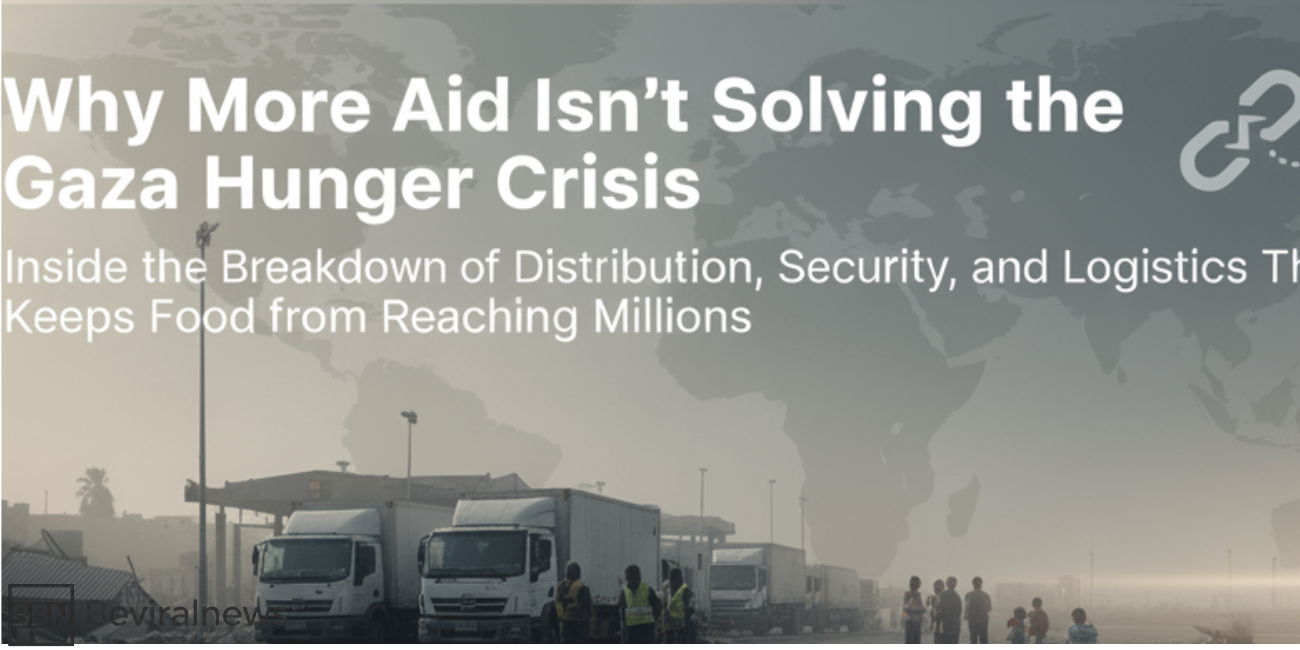
The core paradox is the severe and widening gap between the arrival of humanitarian aid and the actual distribution of that aid to civilians.
On one hand, international partners and media reports often highlight an “increase” or “surge” in the number of aid trucks (e.g., from 50 per day to 150 per day) permitted to enter the Gaza Strip through crossings like Rafah (from Egypt) or Kerem Shalom (from Israel).
On the other hand, virtually every major humanitarian body on the ground—from the United Nations World Food Programme (WFP) to UNICEF and the World Health Organization (WHO)—reports a deepening crisis. They publish data showing rising child malnutrition, widespread disease, and a population on the brink of famine.
This disconnect is not about a lack of aid existing in principle. It’s a crisis of logistics, access, and security. The aid is stacking up at the border because the “last mile”—the journey from the truck to a family’s hands—is broken.
Why This Disconnect Matters: The Human Cost of Famine
This logistical failure has immediate, life-and-death consequences. The “why” matters because it highlights a system failing to prevent a man-made famine.
The global standard for measuring food crises, the Integrated Food Security Phase Classification (IPC), has repeatedly warned of imminent famine in northern Gaza and catastrophic hunger across the entire strip.
- IPC Phase 5 (Catastrophe/Famine): This is the highest and most severe classification. It means households are experiencing an extreme lack of food, leading to starvation, death, destitution, and extremely critical levels of acute malnutrition.
- The U.S. Government Perspective: Agencies like USAID (United States Agency for International Development) rely on IPC data to direct humanitarian responses. The persistence of Phase 5 conditions, despite aid deliveries, signals to the entire world that the current mechanism is failing.
- Irreversible Damage: For children, the impact is devastating. Severe acute malnutrition (SAM) can cause stunting and cognitive damage that lasts a lifetime, even if the child survives. This creates a lost generation.
The failure to connect aid with people means that while food sits in trucks, children are dying of starvation and dehydration just miles away. This is the human stake of the logistical breakdown.
How Aid Delivery Fails: A Breakdown of the Logistical Chain
Saying “distribution is the problem” is too simple. The failure is a cascade of interconnected breakdowns. Getting aid from the border to a person in northern Gaza requires a chain of events, and every single link in that chain is currently broken.
1. The Bottleneck at the Border
Before aid even enters Gaza, it faces significant hurdles.
- Intensive Inspections: All aid, whether from Egypt or Jordan, is routed through Israeli-controlled crossings like Kerem Shalom or Nitzana for inspection. This process is slow and meticulous.
- Rejected Items: Humanitarian groups report that items are often rejected for “dual-use” concerns (items that could theoretically be used for military purposes). This can include basic survival equipment like generators for hospitals, water purification kits, or even tent poles. A single rejected item on a truck can force the entire convoy to be repackaged and resubmitted, losing critical days.
2. The “Last Mile” Collapse: Why Aid Stops Moving
Once a truck is “cleared” and enters Gaza, it faces the main challenge: a total breakdown of civil order and logistics.
- The Security Vacuum: This is the single most critical factor. To distribute aid, humanitarian workers need a safe environment. In Gaza, that environment is gone.
- Active military operations make movement lethally dangerous.
- The local police force, which aid agencies like the UN used to rely on to secure convoys and warehouses, is no longer functioning.
- This “security vacuum” has been filled by two groups: desperate civilians who swarm convoys simply to get food for their families, and armed criminal gangs or militants who loot the aid for profit or control.
- WFP (World Food Programme) officials have stated they had to pause deliveries to the north precisely because their convoys were being swarmed, looted, or fired upon, making safe distribution impossible.
3. The Logistical Nightmare: No Fuel, No Trucks, No Roads
Even if security were guaranteed, the basic tools of logistics no longer exist.
- Lack of Fuel: This is the lifeblood of all humanitarian operations. Without fuel, you cannot run the trucks to move the food, power the generators for the few remaining hospitals, or operate water desalination plants. Aid convoys themselves are often blocked from bringing in necessary fuel.
- Lack of Vehicles: The UN and other NGOs have had their fleet of trucks and armored vehicles damaged, destroyed, or left without fuel.
- Destroyed Infrastructure: Roads are cratered from airstrikes, filled with debris, and impassable. Warehouses where aid could be safely stored and staged have been destroyed.
4. The Infrastructure Collapse: You Can’t Eat Raw Flour
A common and tragic scenario involves aid trucks delivering 50-pound bags of raw flour. This highlights a fundamental misunderstanding of the crisis.
- No Bakeries: The vast majority of Gaza’s bakeries have been destroyed or have shut down due to a lack of fuel, water, and flour.
- No Clean Water: People cannot make dough without clean water, which is almost nonexistent. Water pipes are shattered, and purification plants are offline.
- No Cooking Fuel: Families have no electricity, gas, or even wood to build a fire to bake bread if they could make the dough.
Aid is not just food; it’s the entire ecosystem that makes food edible: clean water, cooking fuel, and basic security. Delivering flour to a starving population that cannot cook it does not solve the hunger crisis.
Expert Analysis: Is the “Surge” of Aid Even Enough?
Humanitarian and logistical experts point out another hard truth: even if all 150-200 trucks per day were distributed perfectly, it would still be catastrophically insufficient.
- Pre-War Baseline: Before the conflict, Gaza relied on an average of 500 to 600 trucks per day. This was not just aid; it was a mix of humanitarian aid and commercial goods—food, supplies, and materials that powered a functioning economy.
- Total Societal Collapse: Today, that economy is gone. Agriculture has collapsed. Stores are empty. 100% of the population is now almost 100% dependent on aid for everything.
- The Real Need: Aid officials estimate that to simply meet the barest minimum survival needs (not to rebuild, just to stop famine), Gaza requires at least 500 trucks of diversified aid every day. This includes food, massive quantities of medical supplies, water purification tablets, fuel, and shelter materials.
The current “surge” is a fraction of what’s needed to sustain 2.2 million people in a state of total collapse. This makes the competition for the few resources that do get in even more desperate and violent.
Real-World Examples of the Breakdown
Example 1: The Airdrops
The U.S., Jordan, and other nations have conducted airdrops of food. While visually compelling, aid workers on the ground are nearly unanimous in their assessment:
- Inefficient and Expensive: Airdrops deliver a tiny fraction of the aid a truck convoy can carry, at a massive cost.
- Dangerous: They are a “last resort” that signals the failure of ground access. Parachutes can fail, and pallets can injure people on the ground.
- Indiscriminate: Aid is scattered and often collected by the strongest, not the most needy (like the sick, elderly, or children).
Example 2: The U.S. Maritime Pier (JLOTS)
The construction of a temporary floating pier (Joint Logistics Over-the-Shore) to bring in aid by sea is another example of a high-effort workaround.
- Bypassing the Problem: This maritime corridor attempts to bypass the land crossings but ultimately faces the exact same problem: once the aid lands on the beach, there is still no safe or functional system to move it from the pier to the people in need, especially in the north.
- Logistical Hurdle: It requires a massive military and logistical footprint to operate, all to solve a distribution problem that persists just miles inland.
Related Concepts: Understanding the Broader Humanitarian Framework
- Humanitarian Corridors: This refers to designated “safe routes” that allow aid to pass through an active conflict zone without being targeted. The lack of reliable, respected corridors is a primary reason aid cannot move.
- International Humanitarian Law (IHL): A set of rules that, in wartime, seek to limit the effects of armed conflict. A key tenet is the obligation to allow and facilitate rapid and unimpeded passage of humanitarian relief for civilians in need.
- The Role of UNRWA: The United Nations Relief and Works Agency for Palestine Refugees is central to this crisis. Before the war, it was the largest aid distributor in Gaza, with a massive infrastructure of schools, clinics, and warehouses. Its sidelining and the targeting of its facilities and staff have been a devastating blow to the physical capacity to distribute aid, regardless of who provides it.
Frequently Asked Questions (FAQ)
- Why can’t more aid trucks get into Gaza?
The main bottlenecks are the slow and complex inspection processes at the few open land crossings (like Kerem Shalom and Rafah) and the limited hours and capacity of these crossings. The volume of trucks being processed is far below pre-war levels and nowhere near the assessed humanitarian need.
- Who is responsible for distributing aid inside Gaza?
Primarily United Nations agencies like the World Food Programme (WFP) and UNRWA, along with partners like the Palestinian Red Crescent and other international NGOs. However, their ability to operate is crippled by the active conflict, lack of security, fuel shortages, and destroyed roads.
- Are airdrops and sea piers effective solutions for the hunger crisis?
No. Humanitarian experts are clear that airdrops and sea routes are last-ditch, inefficient, and inadequate substitutes for mass-scale land access. They signal the failure of safe, overland routes, which are the only way to deliver the volume of aid needed to stop a famine.
- What is the difference between hunger and famine?
“Hunger” is a general term. “Famine” is a specific, technical classification (Phase 5) by the IPC. It is declared when a certain percentage of a population faces extreme food shortages, acute malnutrition (over 30% of children), and death (2 deaths per 10,000 people daily). Gaza is on the brink of this technical declaration.
- What is actually needed to solve the hunger crisis in Gaza?
According to the UN and all major aid groups, the only solution is an immediate ceasefire combined with full, safe, and unfettered humanitarian access to all parts of Gaza. This must include massive scale-ups of food, clean water, medicine, and fuel, as well as a restoration of security and civil order to allow for safe distribution.
Conclusion: More Than Trucks Are Needed
The tragedy of Gaza’s hunger crisis is not a lack of food at the border; it is the systemic collapse of security, law, and logistics inside Gaza. The reported “surge” in aid, while better than nothing, is a drop in the ocean compared to the actual need.
The key takeaway is that this crisis cannot be solved by simply counting trucks. Solving catastrophic hunger requires a complete paradigm shift: an immediate end to hostilities and the restoration of a secure, functional distribution system that allows humanitarian workers to safely reach every person in need with the volume and type of aid required to survive.
Understand the complete picture of the humanitarian challenges. Explore more expert analysis on aid logistics and food security to stay informed on this critical issue.