
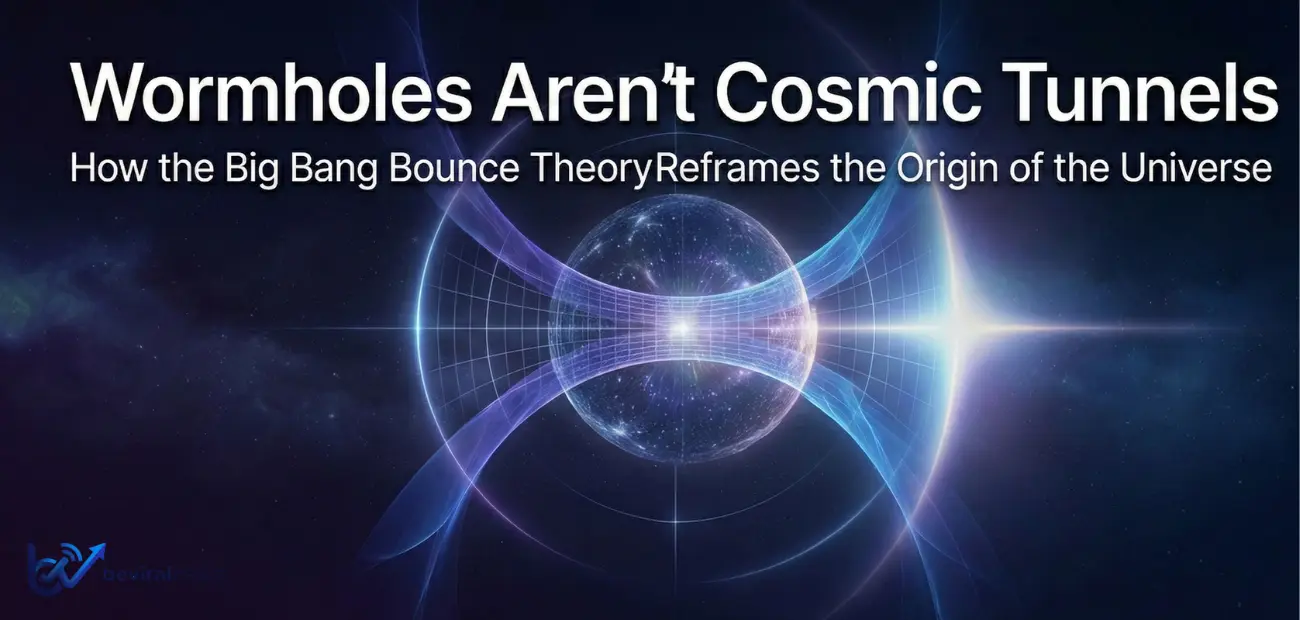
The big bang bounce theory suggests the universe did not begin from nothing, but rebounded from a previous collapsed state.
In this view, wormholes in cosmology are not shortcuts through space, but mathematical features that allow a smooth transition through extreme density.
The takeaway is simple: the universe before the Big Bang may be physically describable, not unknow
The big bang bounce theory proposes that the universe expanded after a prior contraction, instead of starting from a singular beginning.
New work shows wormholes in cosmology may stabilize this bounce under quantum gravity, avoiding infinite densities.
This reframes the origin of the universe as a transition, not a creation event.
Why This Matters
Many explanations of the universe still stop at a singularity and call it “the beginning.”
That answer feels complete, but it avoids the hardest problem: physics breaks down at infinite density.
Students and professionals who follow science news often sense this gap, but don’t see where newer models actually improve the picture.
What matters here is not philosophy.
It is whether modern physics can describe the universe before the Big Bang without hand-waving or undefined math.
This guide explains exactly what works, what doesn’t, and how to choose correctly.
The Real Problem With the Traditional Big Bang Model
The standard Big Bang model explains expansion well.
It does not explain the starting point.
At time zero, equations based on general relativity produce infinities.
Density becomes infinite.
Temperature becomes infinite.
Predictive power disappears.
In real-world physics, infinities are warning signs, not answers.
A common mistake is assuming this is acceptable because “nothing came before.”
That idea is philosophical, not physical.
Physics models are expected to remain valid or be replaced where they fail.
Why “Wormholes as Tunnels” Misses the Point
Most people hear “wormhole” and imagine a tunnel connecting two distant regions of space.
That picture comes from science fiction, not working cosmology.
In quantum gravity wormholes, the role is different.
They act as geometric regulators, not travel routes.
In real-world use of the equations, these structures:
- Prevent spacetime from pinching into a singular point
- Allow continuity through extreme compression
- Exist mathematically, even if not traversable
This distinction matters because the bounce does not require exotic shortcuts.
It requires stable geometry under pressure.
How the Bounce Model Actually Works
In a cosmology bounce model, the universe goes through three phases:
- Long-term contraction
- A minimum-size state governed by quantum gravity
- Expansion into the universe observed today
The key is step two.
Instead of infinite density, quantum effects dominate.
Most users notice confusion here.
The bounce is not a reversal caused by an explosion.
It is a transition caused by repulsive quantum spacetime effects.
Frameworks inspired by Loop Quantum Gravity show how spacetime itself can resist collapse.
Wormhole-like structures appear naturally in these calculations.
What This Suggests About the Universe Before the Big Bang
If the bounce holds, the universe before the Big Bang was not empty or undefined.
It had structure.
It had time.
It followed physical rules.
That does not mean it looked like the current universe.
A limitation often ignored is that matter behavior during contraction may differ radically.
A practical way to think about it:
- Predictable laws still applied
- Observable features are mostly erased by the bounce
- Only subtle imprints may survive
This is why direct observation is difficult, but not impossible.
Evidence: What Supports — and What Limits — the Theory
No bounce model is proven.
That matters.
What supports it:
- It removes singularities without violating known physics
- It aligns with quantum gravity expectations
- It produces testable predictions in cosmic background patterns
What limits it:
- Observational signals are extremely weak
- Competing inflation models also fit current data
- Some versions require assumptions not yet verified
In balanced reasoning, this is a viable contender, not a replacement.
How Wormholes Fit Without Breaking Physics
In this theory, wormholes in cosmology are not objects floating in space.
They are solutions to spacetime equations under extreme conditions.
A useful comparison is stress relief in materials.
When pressure becomes too high, structure changes prevent fracture.
Here, geometry adapts.
Most readers assume wormholes require exotic matter.
In bounce models, they emerge from quantum corrections alone.
This is where the idea becomes practical rather than speculative.
When the Bounce Model Works — and When It Doesn’t
It works best when:
- The goal is removing singularities
- Quantum gravity effects are included
- The focus is early-universe consistency
It struggles when:
- Precise observational confirmation is demanded
- Classical-only equations are enforced
- Simplified inflation assumptions dominate analysis
This is not a weakness unique to the bounce.
It reflects the current limits of cosmology itself.
Who Should Take This Theory Seriously — and Who Shouldn’t
This is for:
- Readers interested in origin of the universe theories beyond textbooks
- Students comparing competing cosmology frameworks
- Professionals who value mathematical consistency over tradition
This is not for:
- Those seeking definitive proof today
- Readers expecting easy visual analogies
- Anyone treating science as settled narrative
A decision filter helps here.
If uncertainty feels uncomfortable, this topic will frustrate rather than inform.
Common Mistakes That Lead to Wrong Conclusions
- Treating wormholes as physical tunnels
- Assuming “before the Big Bang” violates science
- Believing bounce models reject expansion evidence
- Confusing mathematical possibility with confirmation
Most failed explanations online trace back to one of these errors.
How This Compares to Other Origin Theories
Compared to inflation-only models, the bounce:
- Solves the singularity problem
- Adds complexity rather than simplifying assumptions
Compared to cyclic universes:
- Requires fewer repeating conditions
- Avoids infinite past paradoxes
Compared to creation-from-nothing ideas:
- Remains within physical law
- Avoids metaphysical claims
This does not make it correct.
It makes it competitive.
FAQ
Does the big bang bounce theory mean the universe is eternal?
Possibly, but not necessarily.
Some models allow an infinite past, others begin with a first contraction.
Are wormholes real in this theory?
They are mathematical features, not travel passages.
They stabilize spacetime instead of enabling movement.
Can this be proven with current telescopes?
Not directly.
Only indirect signals in cosmic background data are possible.
Does this replace the Big Bang?
No.
It replaces the singularity, not the expansion.
It is respected but not dominant.
Most cosmologists treat it as a serious alternative, not consensus.
Final Takeaway
The big bang bounce theory reframes the origin of the universe as a physical transition, not an unexplained starting point.
By reinterpreting wormholes in cosmology as stabilizing structures under quantum gravity, it removes the need for infinities without discarding known evidence.
With a clear understanding of how this works, readers can now evaluate origin of the universe theories based on consistency and limits — without guesswork.