Summary
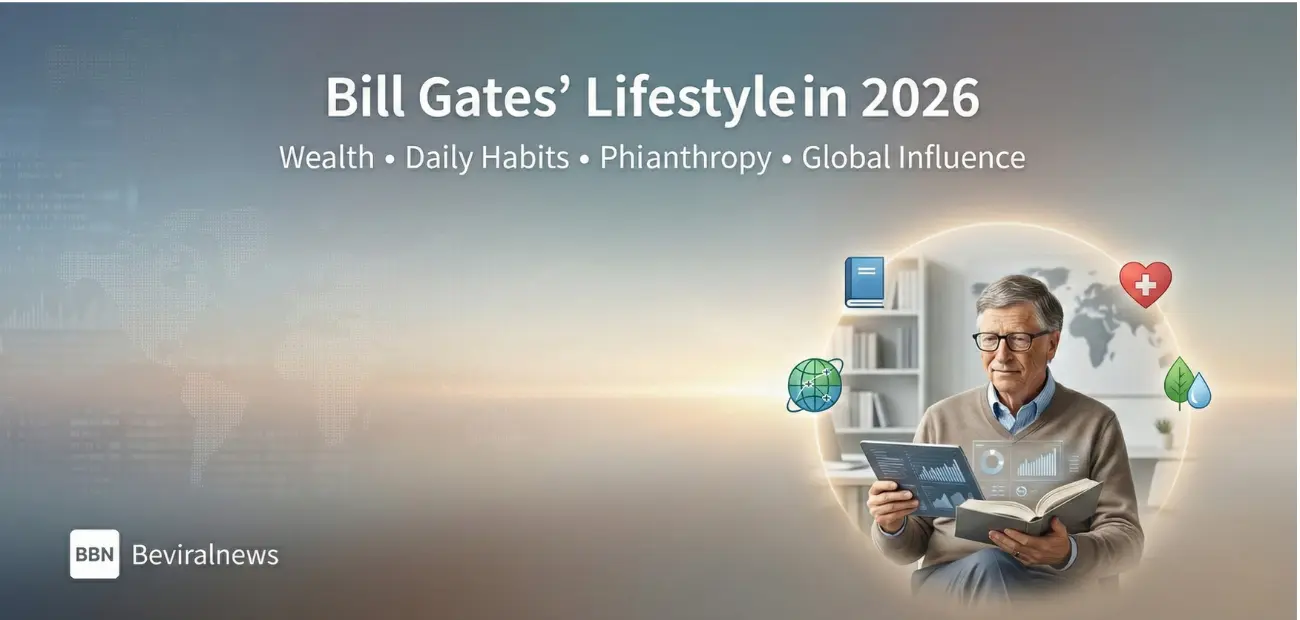
In 2026, Bill Gates’ lifestyle reflects a deliberate shift from traditional billionaire excess toward influence, learning, and long-term global impact. While his wealth still enables exceptional comfort and access, daily habits, philanthropic priorities, and public engagement increasingly define how that wealth is used. The result is a lifestyle shaped less by status and more by stewardship, curiosity, and problem-solving at global scale.
A Life Redefined Beyond Silicon Valley Wealth
For decades, Bill Gates symbolized the archetype of the technology billionaire: brilliant, intense, and singularly focused on building one of the world’s most powerful companies. That image no longer captures reality. By 2026, Gates’ lifestyle illustrates how extreme wealth can evolve into something quieter, more structured, and far more consequential than consumer luxury.
What many lifestyle profiles still miss is the shift in orientation. The focus is no longer accumulation or corporate dominance. Instead, Gates’ day-to-day life revolves around systems thinking—health, climate, education, and global inequality—applied with the same analytical rigor once reserved for software. This evolution matters now because it mirrors a broader change in how modern wealth, particularly tech-originated wealth, is increasingly judged not by scale alone but by outcomes.
Wealth Without Excess: How Net Worth Translates Into Daily Living
Bill Gates remains one of the wealthiest individuals on the planet, yet his material lifestyle appears intentionally restrained relative to his financial capacity. Multiple residences, private travel, and high-level security are part of necessity rather than indulgence. What stands out is the absence of conspicuous consumption as a defining feature.
The relationship between Bill Gates’ net worth and lifestyle is less about luxury goods and more about optionality. Wealth functions as infrastructure: enabling travel to global health sites, convening policymakers, funding experimental solutions, and supporting research that might otherwise be impossible. This reframing challenges the common assumption that billionaire lifestyles are primarily aspirational or aesthetic.
In practical terms, Gates’ spending patterns suggest a prioritization of durability and privacy over novelty. Homes are technologically advanced but not publicly flaunted. Personal assets serve utility and efficiency, not social signaling. This approach reflects a broader trend among post-founder billionaires who view visibility as a liability rather than an asset.
Inside the Daily Rhythm: Structure, Learning, and Mental Discipline
The idea of a rigid, clock-driven schedule no longer defines Bill Gates’ daily routine. Instead, his days are organized around cognitive energy and information flow. Reading remains central, with a consistent emphasis on books, research papers, and long-form analysis rather than short-form media.
What distinguishes Gates’ daily habits in 2026 is intentional intellectual friction. He actively seeks material that challenges assumptions, particularly in fields outside his original expertise, such as epidemiology, climate science, and agricultural economics. This habit reinforces a mindset that prioritizes synthesis over speed.
Meetings are fewer but deeper, often centered on problem diagnosis rather than status updates. Time is allocated to scenario modeling, reviewing data trends, and evaluating second-order effects—skills refined during his Microsoft years but now applied to societal-scale issues.
This approach offers a subtle but powerful lesson: productivity at the highest levels is less about volume and more about cognitive leverage. Many professionals emulate surface-level routines without recognizing that Gates’ effectiveness comes from disciplined thinking environments, not rigid schedules.
Habits and Mindset: Curiosity as a Long-Term Strategy
Bill Gates’ habits and mindset reveal a consistent throughline: curiosity treated as a strategic asset. Unlike motivational narratives that frame mindset as positivity or hustle, Gates’ approach emphasizes skepticism, evidence, and iteration.
A defining habit is his willingness to publicly revise positions when evidence changes. Whether addressing climate pathways or public health strategies, Gates demonstrates intellectual flexibility that contrasts with the certainty often expected from influential figures. This adaptability reinforces credibility over time.
Equally important is his comfort with slow progress. Many global problems resist quick wins, and Gates’ mindset accepts incremental improvement as meaningful. This patience, combined with capital and persistence, enables engagement with challenges that deter short-term thinkers.
The overlooked insight here is that Gates’ mindset is less inspirational than operational. It functions as a decision-making framework optimized for uncertainty, making it particularly relevant for leaders navigating volatile technological and economic landscapes.
Philanthropy as Systems Design, Not Charity
Bill Gates’ philanthropy and charity work in 2026 operates less like traditional giving and more like applied systems engineering. The Bill & Melinda Gates Foundation continues to focus on global health, poverty reduction, and education, but its methods increasingly emphasize data integration, policy alignment, and scalability.
Rather than funding isolated interventions, Gates-backed initiatives often target leverage points: vaccine distribution infrastructure, agricultural resilience, and health data systems. This strategy reflects a belief that durable impact emerges from strengthening underlying systems, not temporary relief.
One limitation of this approach, however, is its reliance on institutional cooperation. System-level change can be slow, politically complex, and vulnerable to external disruptions. Critics argue that such philanthropy risks overconfidence in technocratic solutions. Gates’ response has been to increase transparency, publish assumptions, and invite external critique—an uncommon practice that reinforces trust.
This model of philanthropy influences how other high-net-worth individuals structure their giving, shifting expectations from generosity alone to measurable effectiveness.
Influence Without Office: Shaping Global Issues Informally
Despite holding no elected position, Bill Gates’ influence on global issues remains substantial. His impact flows through advisory roles, funding priorities, and agenda-setting rather than direct authority. Governments, NGOs, and research institutions frequently align initiatives with Gates-backed frameworks due to their credibility and resource backing.
In 2026, this influence is most visible in global health preparedness, climate adaptation technologies, and education reform. Gates’ role often involves amplifying underfunded issues until they reach policy relevance, a function increasingly critical in fragmented information environments.
The tradeoff is visibility. Informal influence can generate skepticism about accountability and democratic oversight. Gates has responded by emphasizing collaboration with public institutions rather than parallel power structures, reinforcing legitimacy through partnership.
This model illustrates a new form of leadership emerging among post-corporate elites: influence exercised through coordination rather than command.
Technology, Climate, and the Next Phase of Impact
Technology remains central to Gates’ worldview, but not as an end in itself. In 2026, his focus is on applied innovation—tools that reduce emissions, improve crop yields, or enhance disease detection. Software thinking persists, but outcomes are measured in human and environmental terms.
One frequently overlooked aspect is Gates’ support for unglamorous solutions. While public attention gravitates toward breakthrough technologies, many Gates-funded projects optimize existing systems: improving cold-chain logistics, refining data interoperability, or lowering manufacturing costs.
This pragmatic orientation challenges the narrative that progress depends solely on radical innovation. Instead, it underscores the cumulative power of refinement and deployment—an insight with broad implications for investors and policymakers alike.
Lifestyle as Signal: What Bill Gates Represents in 2026
Bill Gates’ lifestyle functions as a cultural signal about modern wealth. It suggests that relevance, not luxury, defines success at the highest levels. Time, attention, and credibility become scarcer resources than money itself.
For entrepreneurs and professionals, the takeaway is not imitation but interpretation. Gates’ choices highlight the importance of aligning resources with long-term values rather than short-term recognition. This alignment increases resilience and influence over time.
Suggested internal reading paths for deeper context include:
- How Tech Wealth Is Reshaping Modern Philanthropy
- The Evolution of Billionaire Leadership Beyond Corporate Power
- Purpose-Driven Living Among High-Net-Worth Individuals
Common Misconceptions About Gates’ Lifestyle
A persistent misconception is that Gates has retreated from relevance after stepping back from Microsoft. In reality, his influence has diversified rather than diminished. Another is that his lifestyle is austere; while understated, it remains highly privileged, optimized for effectiveness rather than frugality.
Perhaps the most misleading assumption is that such a lifestyle requires extreme wealth to replicate. Many underlying principles—structured learning, evidence-based decision-making, and long-term orientation—scale down effectively and remain accessible to a much broader audience.
Recognizing these nuances prevents superficial comparisons and enables more realistic inspiration.
Frequently Asked Questions
Is Bill Gates still actively working in 2026?
Yes. While not involved in day-to-day corporate operations, Gates remains deeply engaged in philanthropic strategy, research evaluation, and global issue advocacy.
Does Bill Gates live a minimalist lifestyle?
Not strictly. His lifestyle prioritizes function and privacy over excess, but it still includes resources and comforts aligned with his responsibilities and security needs.
How does Bill Gates spend most of his time now?
Time is largely devoted to reading, strategic meetings, philanthropy oversight, and engagement with global health, climate, and education initiatives.
What motivates Bill Gates’ philanthropy today?
A focus on scalable impact and systemic change drives his giving, with an emphasis on data, collaboration, and long-term outcomes.
Has his mindset changed since leaving Microsoft?
The core analytical approach remains, but it is now applied to broader societal challenges rather than competitive business environments.
Closing Perspective: Influence as a Long Game
Bill Gates’ lifestyle in 2026 offers a reframed understanding of success at scale. Wealth remains present, but it no longer defines the narrative. Instead, habits, mindset, and sustained engagement with complex problems shape a life oriented toward influence rather than display.
For observers, the most valuable insight is not how Gates lives, but why his choices increasingly prioritize leverage over visibility. In a world facing systemic challenges, that orientation may prove more enduring than any measure of net worth.