
Summary
The Epstein files refer to a growing body of court records, investigative materials, and verified disclosures connected to the criminal cases and civil litigation surrounding Jeffrey Epstein and his associates. As of 2026, these documents collectively clarify how abuse networks operated, which facts are legally substantiated, and where unanswered questions still remain. Their significance today lies less in shock value and more in how verified records reshape accountability, institutional trust, and future enforcement standards.
Introduction: Why the Epstein Files Still Matter in 2026
For many readers, the Epstein story feels “finished”—a scandal already processed, judged, and absorbed into public memory. That assumption is precisely where understanding breaks down. While headlines peaked years ago, the documentary record continues to evolve, and the most consequential insights have emerged slowly through verified disclosures rather than dramatic revelations.
What most coverage still oversimplifies is the distinction between allegation, evidence, and legally established fact. The Epstein files are not a single release or list of names. They are a layered archive of sworn testimony, financial records, contemporaneous communications, judicial rulings, and investigative timelines that, when read together, explain not only what happened but how systems failed to intervene sooner.
In 2026, the relevance is no longer confined to Epstein himself. The documents increasingly function as a case study in institutional blind spots, prosecutorial discretion, media amplification errors, and the long-term consequences of deferred accountability.
What the “Epstein Files” Actually Contain — and What They Do Not
A persistent misconception is that the Epstein files represent a secret dossier or definitive roster of co-conspirators. In reality, the term is shorthand for multiple categories of public and court-released material, each governed by different legal standards and evidentiary weight.
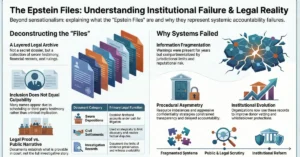
At their core, these materials include sworn depositions, sealed and unsealed filings, exhibits entered into civil cases, investigative correspondence, plea agreements, and posthumous disclosures tied to ongoing litigation. Each category answers different questions and must be interpreted within its procedural context.
Crucially, inclusion in a document does not equal culpability. Many names appear because of contact, scheduling, or third-party testimony rather than criminal implication. This distinction is often blurred in public discourse but is explicit in the legal record itself.
Understanding this framework is essential, because the files are most informative when read for patterns of behavior and institutional response—not for isolated claims.
From Fragmented Allegations to a Coherent Evidence Timeline
One of the most valuable outcomes of recent disclosures is the ability to trace a verified sequence of events rather than relying on retrospective narratives. The Epstein evidence timeline now illustrates how warnings accumulated over years while enforcement responses remained inconsistent.
Early indicators—such as repeated complaints, local law enforcement reports, and unusual financial arrangements—did not exist in isolation. The documents show how these signals were present but compartmentalized, preventing escalation. This fragmentation explains why accountability lagged even when credible information existed.
What becomes clear in hindsight is that delay was not driven by lack of information but by structural incentives: jurisdictional limits, prosecutorial negotiations, and reputational risk management. The files provide a rare longitudinal view of how these forces interact over time.
This reframing matters because it challenges the comforting belief that abuse networks collapse only when evidence appears. In reality, evidence often precedes action by years.
Court Filings as Windows Into Power and Process
Epstein court filings are often misunderstood as narrative documents. They are not written to tell a story but to establish legal positions. That makes them more reliable—and more difficult to interpret—than media summaries.
Recent unsealed materials reveal how aggressively confidentiality was pursued and how settlements functioned to limit discovery rather than resolve factual disputes. These strategies were lawful but consequential, shaping what information entered the public record and when.
For legal and policy professionals, the insight is less about any single filing and more about procedural asymmetry. The files illustrate how resource imbalance can constrain transparency even in high-profile cases, reinforcing calls for reform in how civil abuse claims intersect with criminal investigations.
What the Jeffrey Epstein Documents Confirm Beyond Dispute
Despite widespread speculation, the most important confirmed findings are surprisingly narrow—and therefore powerful.
The documentary record establishes that Epstein operated a sustained pattern of abuse involving minors, facilitated by logistics, compensation structures, and intermediaries. This is no longer a matter of debate. It also confirms that multiple institutions—financial, legal, and social—interacted with Epstein in ways that failed to trigger effective intervention.
What the documents do not uniformly establish is the criminal liability of every individual mentioned. The distinction between corroborated conduct and contextual association is explicit in the records but often ignored elsewhere.
This clarity changes how responsible analysis is conducted. It shifts attention away from rumor amplification and toward systemic vulnerabilities that allow exploitation to persist.
Investigation Records and the Limits of Retrospective Accountability
Epstein investigation records reveal another overlooked reality: investigations are bounded by time, evidence preservation, and witness availability. Several lines of inquiry reached dead ends not because allegations were false, but because corroboration thresholds could no longer be met.
This limitation has fueled public frustration, but it also underscores a structural truth. Accountability mechanisms are strongest when activated early. The files demonstrate how delayed scrutiny compounds harm—not only to victims but to institutional credibility.
In policy discussions across the US, UK, EU, and Australia, these records are now cited in debates over mandatory reporting, inter-agency data sharing, and statute-of-limitations reform.
Disclosures, Transparency, and the Cost of Partial Truths
Epstein case disclosures have often arrived incrementally, creating cycles of outrage followed by confusion. Each release answered some questions while reigniting others, leading many to assume intentional obfuscation.
The documents suggest a more nuanced reality. Courts balance transparency against privacy rights, ongoing litigation, and evidentiary fairness. This balancing act produces partial visibility—not secrecy by default, but constrained disclosure.
The overlooked risk is interpretive distortion. When fragments are consumed without procedural context, public understanding suffers. The files themselves warn against this by embedding caveats that are frequently omitted in secondary reporting.
A Common Misconception: “The Files Will Name Everyone”
One of the most persistent myths is that a final, definitive release will conclusively identify all wrongdoers. The record does not support this expectation.
Legal documents are reactive, not investigative journalism. They capture what parties can prove to a legal standard at a specific moment. Many relationships remain ambiguous not because truth is hidden, but because proof is insufficient or jurisdictionally unreachable.
This insight reframes expectations. The value of the Epstein files lies not in finality, but in illumination—showing how abuse ecosystems operate and where safeguards fail.
How This Case Has Changed Institutional Behavior
While public attention often focuses on personalities, the more lasting impact is procedural. Financial institutions, universities, and nonprofit boards have quietly revised compliance protocols influenced by lessons drawn from these records.
Adoption trends show increased scrutiny of donor relationships, enhanced background vetting, and stronger whistleblower protections. These shifts rarely make headlines, but they reflect the most constructive legacy of the case.
Many organizations now treat the Epstein files as cautionary documentation rather than scandal artifacts—an indication that learning, however delayed, is occurring.
Why This Still Matters for Informed Citizens
For journalists, researchers, and policy professionals, the Epstein files function as a benchmark for evaluating future disclosures. They set expectations for evidentiary rigor, source verification, and narrative restraint.
For the public, they reinforce a more uncomfortable lesson: accountability is often procedural, incremental, and unsatisfying. Justice rarely arrives as a single moment. It unfolds through records, revisions, and reforms that only become visible with time.
This perspective changes how similar cases are interpreted going forward, reducing susceptibility to sensationalism while increasing demand for verifiable clarity.
Internal Knowledge Pathways Worth Exploring
Readers seeking deeper understanding often continue into adjacent areas, such as:
- How sealed court records are evaluated and unsealed in high-profile civil cases
- The role of non-prosecution agreements in U.S. federal law
- Comparative abuse accountability frameworks across the US, UK, and EU
These topics provide critical context for interpreting disclosures without overreach.
Frequently Asked Questions
What are the Epstein files in simple terms?
They are collections of court records, investigative materials, and verified disclosures related to Jeffrey Epstein’s criminal and civil cases. Together, they document what has been legally established rather than unproven claims.
Do the files prove who else committed crimes?
They confirm Epstein’s conduct and systemic failures but do not uniformly establish criminal liability for all named individuals. Legal proof varies by case and jurisdiction.
Why are new documents still being released years later?
Ongoing litigation, unsealing motions, and procedural timelines govern disclosure. Releases often reflect legal processes rather than new discoveries.
Are all names in the documents accused of wrongdoing?
No. Many names appear due to contact, testimony, or contextual relevance, not accusation or proof.
Why didn’t investigations stop Epstein sooner?
The records show fragmented information, jurisdictional limits, and negotiated settlements that delayed comprehensive intervention.
Conclusion: Understanding Beyond Outrage
The lasting value of the Epstein files is not shock, but structure. They reveal how abuse persists when institutions prioritize discretion over disruption, and how accountability depends on early, coordinated action rather than retrospective reckoning.
For readers in 2026, the most important takeaway is clarity—knowing what is verified, what remains unresolved, and why those distinctions matter. With that understanding, future disclosures can be evaluated more responsibly, and similar failures recognized before they repeat.
At this point, many observers find that the real question is no longer who knew what—but whether systems have learned enough to respond differently next time.