Summary
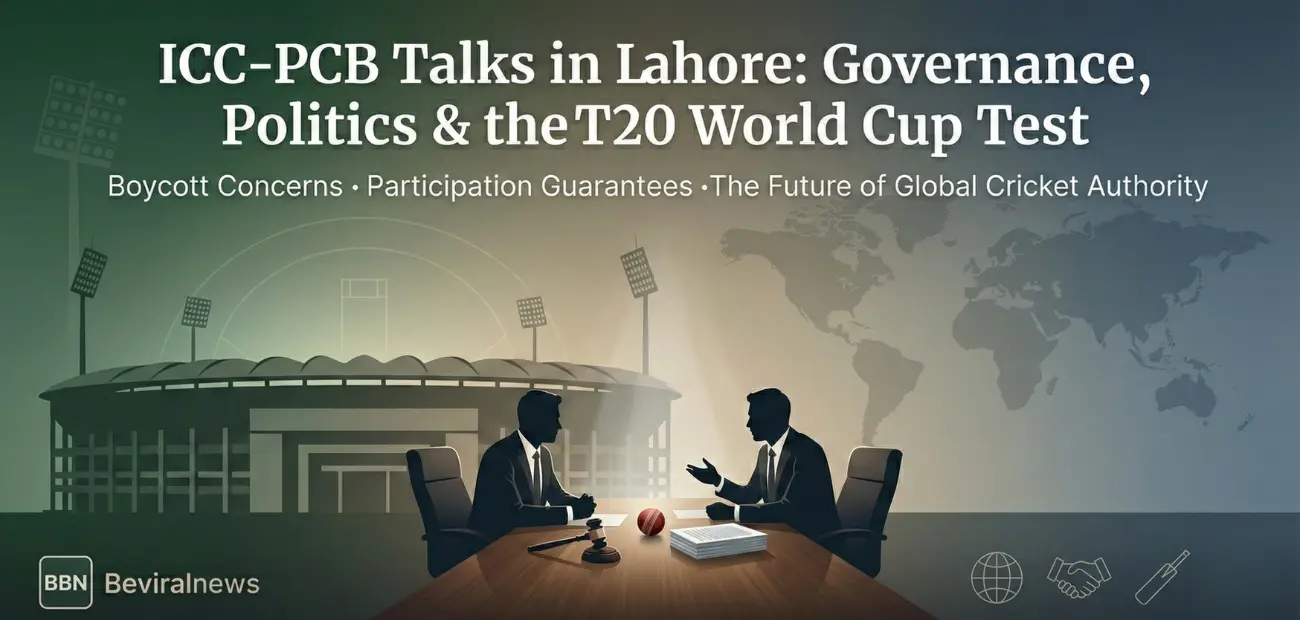
The high-level discussions between the International Cricket Council and the Pakistan Cricket Board in Lahore reflect growing unease over governance, participation guarantees, and political undercurrents surrounding the upcoming T20 World Cup. At the center of the talks is whether unresolved tensions could escalate into a partial or symbolic boycott, reshaping tournament credibility and global cricket relations. These meetings highlight how cricket governance decisions increasingly intersect with diplomacy, risk management, and international perception.
Why These Talks Matter More Than They Appear
International cricket has always existed at the intersection of sport, national identity, and politics. What makes the current moment different is how little margin for error exists ahead of a global tournament designed for maximum commercial reach, broadcast certainty, and fan engagement. The Lahore discussions between the ICC and Pakistan’s cricket leadership are not routine administrative check-ins. They represent a pressure point where governance authority, regional trust, and tournament legitimacy converge.
Most coverage frames the situation as a narrow dispute over participation assurances or scheduling logistics. That framing misses the larger implication: the credibility of international cricket governance is being tested in real time. Decisions taken—or avoided—during these talks will influence how future host nations are evaluated, how boards negotiate leverage, and how political realities are acknowledged without overtly shaping sporting outcomes.
What is at stake is not merely attendance at a single tournament, but whether the current governance model can still function under intensifying geopolitical strain.
The Lahore Setting: Symbolism, Signal, and Strategy
Holding the ICC–PCB meeting in Lahore was itself a calculated choice. Pakistan has spent the better part of a decade rebuilding its case as a safe, viable, and respected host nation after prolonged isolation from international cricket. By welcoming senior ICC officials on home soil, the PCB reinforced a narrative of restored normalcy and administrative maturity.
This location choice also subtly shifted the balance of optics. Rather than Pakistan defending its position from afar, the talks unfolded in an environment where local stakeholders, infrastructure progress, and security frameworks were visible rather than theoretical. For governance negotiations, context matters. Seeing operational readiness firsthand carries a different weight than reviewing reports from a distance.
At the same time, Lahore as a venue underscored the seriousness of the moment. This was not a neutral-site conversation designed to minimize tension. It was a direct engagement, signaling that unresolved issues had reached a level where symbolic reassurance alone would no longer suffice.
Understanding the Boycott Anxiety Beneath the Headlines
The phrase “boycott” often triggers assumptions of outright withdrawal or dramatic public statements. In practice, modern sports boycotts are rarely so absolute. The current T20 World Cup boycott controversy is better understood as a spectrum of risk rather than a binary outcome.
At one end lies full participation with lingering discontent. At the other sits formal non-participation. Between those extremes are softer but still damaging scenarios: delayed confirmations, conditional participation, public dissent from players or officials, or visible reluctance that undermines tournament unity.
For the ICC, even the perception of instability can erode sponsor confidence and broadcast planning. For Pakistan, the concern is different but equally consequential. Any suggestion that its governance disputes or political positioning could marginalize it within the global structure threatens years of reputational rebuilding.
This is why the Lahore meeting carried urgency. The goal was not merely to avert a boycott, but to reduce ambiguity before uncertainty hardens into precedent.
Governance at the Core: More Than a Scheduling Dispute
At the heart of the Pakistan cricket governance dispute lies a familiar but unresolved question: how much autonomy should national boards retain when international tournaments intersect with political realities?
The PCB’s position has consistently emphasized parity—expectations placed on Pakistan, it argues, should mirror those applied to other full-member nations facing political or diplomatic complications. From this perspective, selective scrutiny feels less like risk management and more like institutional imbalance.
The ICC, however, operates within constraints that extend beyond cricket. Host nation agreements, government advisories, and cross-border diplomatic positions all influence what the council can realistically enforce. The challenge is that these external pressures are rarely distributed evenly across member boards.
What the Lahore talks revealed, according to observers close to the process, is a growing recognition that existing governance frameworks were not designed for today’s political density. Informal accommodations that once resolved tensions quietly are now scrutinized publicly, amplified by media cycles and fan-driven narratives.
The Broader Context of ICC–Pakistan Relations in 2026
The state of ICC Pakistan relations in 2026 cannot be separated from the accumulation of decisions made over the previous decade. Pakistan’s gradual reintegration into hosting, its investments in domestic infrastructure, and its push for administrative credibility have reshaped how it engages with global cricket power centers.
Yet trust, once fractured, rebuilds unevenly. While security assessments have improved, skepticism lingers in subtler forms—travel hesitancy, scheduling compromises, and conditional assurances that other boards rarely face.
What distinguishes the current phase is Pakistan’s willingness to push back through formal channels rather than quiet acquiescence. The Lahore meeting reflected a shift from reactive defense to proactive negotiation. That change alone alters the power dynamics within ICC forums, particularly as other boards watch closely for precedent.
Political Tensions and the T20 World Cup: The Uncomfortable Reality
No global cricket event exists in a political vacuum, but the T20 World Cup political tensions are especially pronounced because of the format’s commercial centrality. T20 tournaments are designed for global audiences, prime-time broadcasting, and cross-market sponsorship. Any disruption carries outsized financial consequences.
This reality creates an uncomfortable incentive structure. The ICC must project neutrality while managing risks rooted in political decisions it cannot control. National boards, meanwhile, are expected to absorb political costs without appearing to politicize sport themselves.
One overlooked dimension is how these tensions affect players. While administrators negotiate at high levels, athletes are left navigating uncertainty about travel, security protocols, and public scrutiny. Over time, this erosion of clarity can influence player sentiment and willingness to engage wholeheartedly in marquee events.
The Lahore talks implicitly acknowledged this human layer, even if it remained off the official agenda.
Information Gain: What Most Coverage Misses
A key limitation in mainstream analysis is the assumption that the outcome hinges solely on Pakistan’s stance. In reality, the ICC faces its own structural vulnerability. If governance appears inconsistent or overly influenced by select member boards, it risks fragmenting authority across regions.
Another commonly missed point is that boycott concerns are not isolated to one board. Quiet apprehension exists among multiple stakeholders who see how quickly political conditions can change. How the ICC handles this situation will shape expectations for future crises involving other nations.
Perhaps the most underappreciated insight is this: the real negotiation is less about this tournament than about decision-making norms. The Lahore meeting functioned as a test case for how openly political realities can be addressed within cricket governance without formalizing them as policy.
That balance—acknowledging without codifying—is difficult to maintain, and missteps here could force the ICC into more rigid, less flexible frameworks down the line.
Risk, Tradeoffs, and Misconceptions
There is a persistent misconception that avoiding confrontation preserves stability. In governance contexts, avoidance often compounds risk. Delaying clarity may keep peace temporarily, but it also increases the likelihood of last-minute crises that damage all parties involved.
For Pakistan, pushing the issue carries reputational risk. Advocacy can be mischaracterized as obstruction, especially in polarized media environments. For the ICC, accommodating concerns too visibly risks accusations of inconsistency or favoritism.
The tradeoff, therefore, is between short-term calm and long-term credibility. The Lahore talks suggested an emerging consensus that controlled transparency—clear positions communicated early—may be less damaging than strategic ambiguity.
This represents a subtle but meaningful shift in how international cricket leadership approaches conflict.
How This Fits Into the Future of Cricket Governance
The implications extend beyond the immediate tournament cycle. As cricket expands into new markets, governance structures will encounter more diverse political landscapes. The ability to manage participation disputes without eroding trust will determine whether the ICC remains a central authority or gradually cedes influence to bilateral agreements and ad hoc arrangements.
In that sense, the Lahore meeting was as much about institutional evolution as it was about crisis management. Observers noted a greater emphasis on documentation, precedent awareness, and mutual accountability—signals that informal understandings are giving way to more explicit frameworks.
This evolution may feel uncomfortable, but it aligns with the sport’s increasing global complexity.
Frequently Asked Questions
Why was Lahore chosen for the ICC–PCB talks?
Lahore provided a symbolic and practical setting, allowing ICC officials to engage directly with Pakistan’s cricket infrastructure and leadership. The location reinforced Pakistan’s position as an active, capable stakeholder rather than a distant negotiator.
Is a full boycott of the T20 World Cup likely?
A full boycott remains unlikely. The greater concern lies in conditional participation or delayed commitments that could undermine tournament planning and perception.
What is the main governance issue between the ICC and PCB?
The core issue revolves around consistency and parity in how political and security-related considerations are applied across member boards, particularly in high-profile tournaments.
How do political tensions affect players directly?
Uncertainty around travel, security protocols, and public scrutiny can distract players and influence their mental readiness, even when participation ultimately proceeds.
Does this dispute affect other ICC member nations?
Yes. Other boards are closely observing how the situation is handled, as it may set precedents for future governance challenges involving different regions.
Conclusion: A Defining Moment Hidden in Plain Sight
The Lahore talks may not produce a single dramatic announcement, but their significance lies in what they reveal about the state of international cricket. Governance is no longer a backstage function; it is part of the sport’s visible narrative. How authority is exercised, challenged, and justified now shapes credibility as much as on-field performance.
For informed observers, the key takeaway is not whether a boycott materializes, but how openly and coherently concerns are addressed. If clarity replaces ambiguity, this moment could strengthen institutional trust. If not, similar crises will recur with greater intensity.
In that sense, the real outcome of the Lahore meeting will unfold over time—measured not just by participation lists, but by whether international cricket emerges more resilient, or more fragmented, in the years ahead.