
Summary
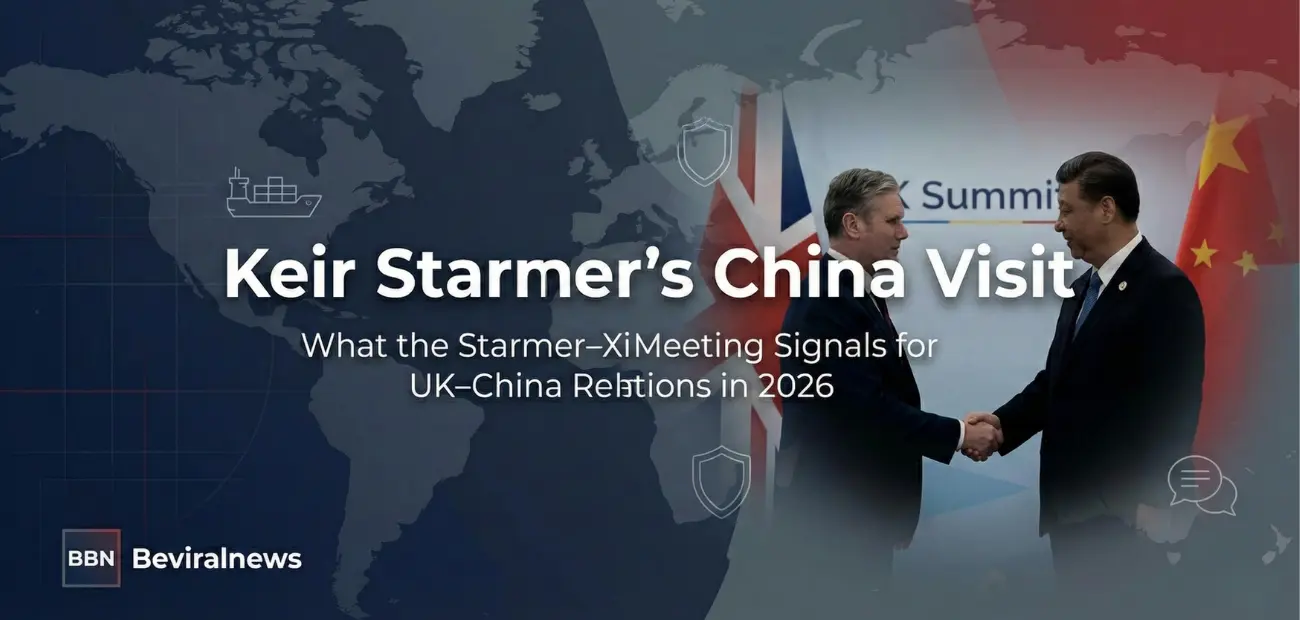
Keir Starmer’s China visit signals a deliberate recalibration of how Britain engages with Beijing at a time of heightened global fragmentation. The Starmer meeting with Xi Jinping reflects a shift toward pragmatic diplomacy, balancing economic necessity with security concerns. For UK–China relations in 2026, the visit suggests cautious re-engagement rather than a full political reset.
A Diplomatic Moment Shaped by Constraint, Not Optimism
When a UK prime minister travels to Beijing, the symbolism often carries more weight than the joint statements that follow. The UK prime minister Beijing visit in this case arrives after years of strained dialogue, muted trade momentum, and growing strategic distrust between China and Western democracies. What makes this moment distinctive is not the promise of rapid improvement, but the recognition—on both sides—that prolonged disengagement carries its own costs.
For London, the challenge is immediate and practical. Economic growth remains fragile, global supply chains are less predictable, and British firms continue to depend on Chinese manufacturing capacity, consumer demand, and investment flows. For Beijing, engagement with a newly elected UK government offers an opportunity to test whether European partners remain open to differentiated relationships, even as transatlantic alignment remains strong.
Most coverage frames the visit as either a thaw or a gamble. That framing misses the deeper reality: this meeting is better understood as damage control with strategic intent, not rapprochement driven by goodwill.
Why This Visit Matters More Than Routine Diplomacy
High-level meetings between Western leaders and Xi Jinping are no longer routine. Each encounter is scrutinized for clues about alliance cohesion, economic realignment, and geopolitical signaling. The geopolitical impact of Starmer China trip lies less in immediate policy shifts and more in what it reveals about Britain’s evolving posture.
Unlike earlier eras, UK–China engagement now operates under three non-negotiable constraints:
- Security alignment with the United States remains foundational.
- Economic interdependence has not disappeared, despite political friction.
- Domestic political tolerance for China engagement is limited and conditional.
Starmer’s approach appears calibrated to operate within these boundaries. The meeting avoids ideological grandstanding while also steering clear of the expansive economic enthusiasm that defined previous UK governments’ engagement strategies. This reflects a broader trend across Europe: diplomacy that seeks stability without strategic dependency.
Reading Between the Lines of the Starmer–Xi Meeting
Official readouts tend to emphasize familiar themes—trade cooperation, climate commitments, cultural exchange. What matters more is what remains understated. Discussions reportedly focused on economic predictability, regulatory transparency, and crisis communication channels. These topics point to risk management rather than expansion.
For Beijing, reassurance that Britain is not actively pursuing economic decoupling carries value. For London, maintaining open channels helps protect British firms operating in China and preserves leverage in multilateral forums.
This is where the Starmer meeting Xi Jinping diverges from symbolic diplomacy. It reflects a working assumption that rivalry and cooperation will coexist, often uncomfortably. The visit does not attempt to resolve fundamental disagreements over human rights, Taiwan, or technology governance. Instead, it acknowledges that unresolved tensions must be managed to prevent escalation and economic collateral damage.
Trade and Technology: Pragmatism Over Illusions
UK China trade and diplomacy now operate in a narrower lane than a decade ago. Large-scale trade expansion is unlikely, particularly in sensitive sectors such as semiconductors, telecommunications, and advanced AI systems. However, areas like green technology, financial services, and consumer goods remain viable points of engagement.
What many analyses overlook is how British companies themselves have adapted. Rather than exiting China wholesale, firms increasingly pursue diversification strategies—maintaining Chinese operations while expanding production or sourcing elsewhere. Government diplomacy that supports regulatory clarity and dispute resolution becomes valuable in this context, even without ambitious new trade deals.
This is a critical insight: the visit is less about opening doors than about preventing existing ones from quietly closing.
The Strategic Signal to Allies and Competitors
Any UK–China diplomatic engagement inevitably sends messages beyond Beijing. Washington, Brussels, Tokyo, and Canberra all watch closely for signs of divergence. In this case, the signal appears deliberately muted.
The visit does not undermine UK alignment with U.S. technology restrictions or security frameworks. Nor does it suggest a return to “golden era” rhetoric. Instead, it reinforces a model of allied autonomy—coordinated strategy with room for national economic interests.
This matters for UK-China relations 2026 because it normalizes a middle ground that many allies quietly pursue but rarely articulate. Engagement is framed as functional, not transformative. That framing reduces friction with partners while preserving national agency.
An Overlooked Risk: Misaligned Expectations
One of the most underestimated risks in high-level diplomacy is expectation asymmetry. Beijing often views renewed engagement as a step toward normalization, while Western governments frame it as stabilization. When those expectations diverge, disappointment follows.
For the UK, the danger lies in domestic backlash if engagement is perceived as concessionary. For China, frustration may arise if symbolic meetings fail to deliver tangible shifts in policy or rhetoric. The success of the Keir Starmer China visit will depend less on public announcements and more on whether both sides internally understand the limits of what was agreed.
This dynamic explains why post-visit silence may be more telling than immediate follow-ups. A lack of dramatic outcomes may actually signal alignment on restraint.
How This Fits Into the Bigger Geopolitical Picture
The broader context is a world where economic blocs are hardening, but not fully separating. Britain occupies a unique position—outside the EU, aligned with the U.S., yet commercially exposed to Asia. Navigating this position requires selective engagement, not binary choices.
The geopolitical impact of Starmer China trip is therefore incremental. It reinforces a pattern of compartmentalization: cooperation where possible, resistance where necessary, and communication always open. This approach is increasingly common among mid-sized powers seeking relevance without overcommitment.
It also reflects a generational shift in political leadership. The emphasis is on predictability and resilience rather than transformation. Stability, even if imperfect, is treated as an achievement.
Frequently Asked Questions
Does this visit signal a reset in UK–China relations?
No. The visit indicates stabilization rather than a reset, focused on managing tensions rather than redefining the relationship.
Why is the Starmer meeting with Xi Jinping significant now?
It occurs at a time when dialogue has been limited and signals an effort to prevent further deterioration amid global uncertainty.
Will UK–China trade increase as a result of the visit?
Major trade expansion is unlikely, but the visit may help preserve existing commercial channels and reduce regulatory friction.
How does this affect UK relations with the United States?
The visit appears carefully aligned with U.S. strategic priorities and does not indicate a shift away from transatlantic cooperation.
What sectors are most impacted by renewed engagement?
Green technology, financial services, and consumer markets are more likely to benefit than sensitive technology sectors.
What to Watch Next
The true measure of this diplomatic moment will emerge over time. Indicators worth monitoring include regulatory treatment of UK firms in China, frequency of follow-up dialogues, and Britain’s positioning in multilateral forums involving China. Absence of conflict escalation may itself be the outcome both sides quietly seek.
Keir Starmer’s China visit does not promise clarity or consensus. What it offers is a disciplined approach to uncertainty—one that accepts geopolitical friction as permanent and focuses instead on managing its consequences. For observers and stakeholders, that realism may be the most consequential signal of all.