
Summary
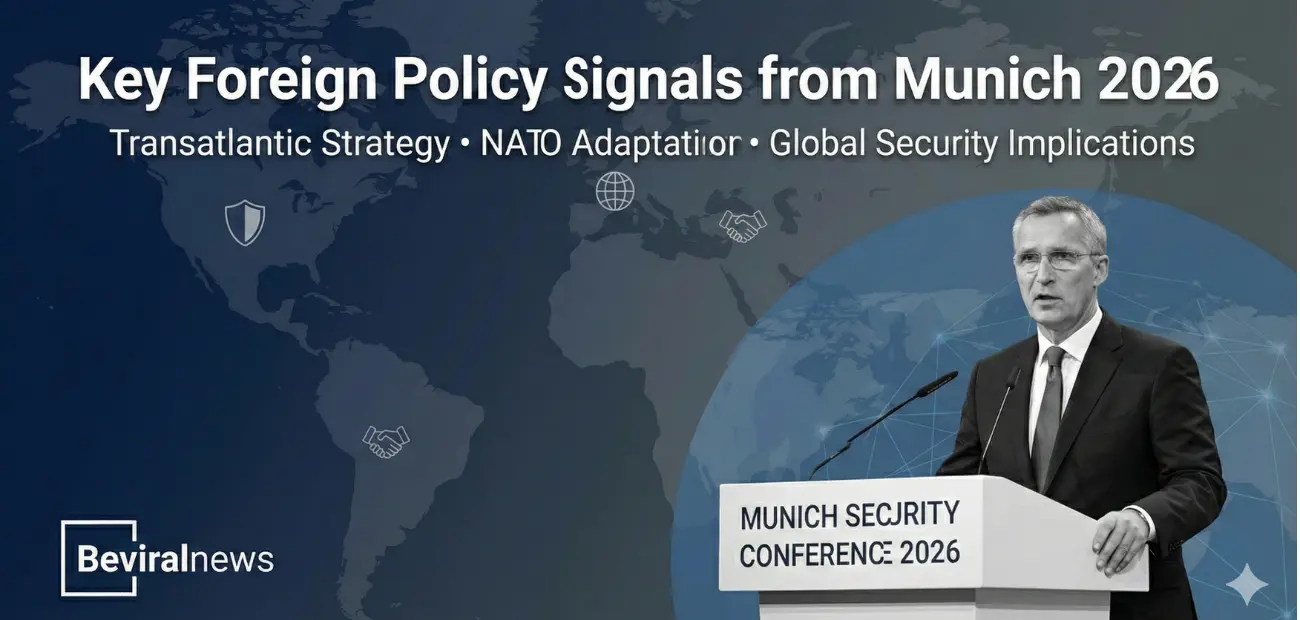
The appearance of Marco Rubio Munich Security Conference 2026 drew attention because it outlined emerging priorities in transatlantic cooperation and defense alignment at a moment of shifting geopolitical risk. Observers noted that the address clarified expectations for alliance burden-sharing, technology-driven defense planning, and recalibration of partnerships across Europe and beyond. For policy professionals tracking strategy shifts, the speech offered signals that extend well beyond a single event.
Introduction: Why This Moment Resonates Beyond a Single Speech
International security gatherings rarely move global debate overnight. Yet certain addresses arrive at moments when diplomatic signals carry unusual weight. Early 2026 has been marked by economic fragmentation, evolving military technologies, and renewed regional tensions, creating heightened sensitivity to messaging from influential policymakers. Within that context, attention surrounding the Marco Rubio foreign policy speech 2026 stemmed less from rhetoric and more from perceived directional guidance.
Coverage often narrows to headlines about alliance funding or military readiness. That approach overlooks the structural themes shaping long-term cooperation: supply-chain resilience, strategic autonomy debates, and the politics of deterrence credibility. Analysts tracking global security decision-making benefit from examining these signals as part of an interconnected policy ecosystem rather than isolated talking points.
The discussion below explores how this address fits into broader strategic conversations unfolding across the transatlantic community, highlighting implications that conventional summaries frequently overlook.
Signals from Munich Reading Between Diplomatic Lines
The Munich Security Conference highlights 2026 demonstrated a familiar yet evolving pattern: public affirmation of unity paired with nuanced messaging about recalibration. Statements emphasized resilience against conventional threats and hybrid challenges, but subtler signals emerged regarding technological sovereignty and intelligence cooperation.
The tone suggested continuity rather than disruption. Yet continuity itself carries strategic meaning when uncertainty dominates geopolitical forecasting. Analysts observed emphasis on maintaining deterrence credibility while avoiding escalatory signaling — a delicate balance reflecting heightened risk management rather than aggressive posturing.
One underappreciated aspect involves the audience composition. The conference gathers policymakers, defense planners, industry leaders, and researchers, creating a multi-layered communication channel. Messaging therefore addresses multiple constituencies simultaneously. References to innovation ecosystems and public-private coordination signal expectations for industrial sectors, while alliance language speaks to diplomatic counterparts.
This multidimensional signaling often influences budget planning and procurement cycles months after the event concludes. Observers who interpret the speech purely through ideological framing risk missing these operational implications.
The Strategic Framing of Transatlantic Relations
Discussion surrounding US–Europe security relations continues to evolve beyond traditional defense commitments. Economic interdependence, digital governance, and energy resilience increasingly shape security collaboration. The speech highlighted these intersections, reinforcing the notion that alliance stability now relies on cross-sector integration rather than military posture alone.
A notable shift in emphasis involved acknowledging Europe’s expanding defense capabilities as complementary rather than competitive. This framing addresses ongoing debate about strategic autonomy — a subject frequently characterized as divisive. By treating capability development as additive, the message attempts to preserve cohesion while accommodating regional initiatives.
However, an overlooked limitation lies in execution complexity. Coordination across regulatory regimes, procurement standards, and political cycles remains uneven. Symbolic alignment does not automatically translate into interoperable capabilities. Analysts should therefore interpret rhetorical convergence cautiously, assessing practical follow-through rather than narrative tone alone.
The broader implication is a reframing of partnership expectations. Instead of viewing transatlantic cooperation as static, it appears increasingly transactional and outcome-driven. This shift reflects structural realities of fiscal pressure and domestic political accountability across multiple governments.
Alliance Deterrence in an Adaptive Security Environment
The conversation surrounding NATO defense strategy 2026 centers on adaptation rather than expansion. Traditional metrics — troop deployments and defense spending — remain relevant but no longer capture the entirety of deterrence credibility. The address underscored evolving dimensions including cyber readiness, AI-enabled intelligence, and integrated logistics.
This perspective challenges common assumptions that modernization simply requires increased funding. In practice, institutional coordination and doctrinal flexibility often determine effectiveness more than raw expenditure. Several alliance planners have noted that integration lag — not resource scarcity — frequently constrains operational readiness.
Tradeoffs also deserve attention. Emphasizing technological capabilities may create perception gaps among member states with varying industrial capacities. Without equitable participation mechanisms, modernization initiatives risk reinforcing asymmetry within the alliance. Such disparities can influence political cohesion over time.
An insight frequently overlooked in media commentary is the psychological dimension of deterrence signaling. Credibility derives not only from capability but from predictability of response. Messaging that emphasizes consultation processes and shared decision frameworks attempts to strengthen that predictability — a subtle but significant strategic element.
Positioning Within a Broader Strategic Doctrine
The address also intersected with ongoing interpretation of the US global security strategy update, reflecting recalibration across multiple theaters simultaneously. Rather than focusing narrowly on regional flashpoints, the narrative connected economic resilience, technological leadership, and defense cooperation as mutually reinforcing pillars.
This holistic framing signals a departure from compartmentalized policymaking. Security strategy now increasingly treats supply chains, data infrastructure, and energy systems as strategic assets subject to protection and coordination. Such perspective aligns with trends observed among allied governments and research institutions examining systemic risk.
Yet a misconception often emerges from this integrated narrative — that expansion of strategic scope guarantees coherence. In reality, broader agendas introduce prioritization challenges. Resource allocation inevitably favors certain objectives over others, requiring continuous reassessment. Analysts should therefore interpret comprehensive messaging as aspirational guidance rather than definitive roadmap.
Another overlooked implication concerns communication with non-allied states. Strategic framing influences perceptions beyond the alliance sphere, shaping diplomatic expectations and economic behavior. Signals delivered in Munich therefore resonate globally, affecting policy interpretation across Asia-Pacific and emerging markets.
Interpreting Political Messaging Beyond Immediate Policy Outcomes
Policy speeches often generate short-term analysis centered on ideological positioning. However, experienced observers evaluate them as iterative contributions to narrative continuity. The Marco Rubio Munich Security Conference 2026 appearance fits within this dynamic, reinforcing themes established in earlier debates while adjusting emphasis toward technological resilience and alliance coordination.
Three contextual factors shape interpretation:
- Domestic political landscapes influencing foreign policy articulation
- Institutional continuity within diplomatic and defense establishments
- Expectations of international partners seeking predictability
Understanding these layers helps prevent overreaction to individual phrasing choices. Messaging reflects both personal viewpoint and institutional constraints, producing a hybrid signal that cannot be evaluated in isolation.
An insight frequently absent from commentary involves the temporal dimension of strategic communication. Policymakers often frame narratives intended to shape decision environments over multiple years. Analysts focusing solely on immediate legislative or operational outcomes may underestimate cumulative influence on agenda setting and funding trajectories.
Overlooked Considerations in Policy Analysis
The analytical discourse surrounding high-profile speeches tends to emphasize explicit commitments while neglecting structural subtleties. Several factors warrant closer scrutiny:
- Implementation capacity: Institutional readiness to operationalize policy direction
- Industrial alignment: Defense sector ability to meet capability ambitions
- Public perception dynamics: Domestic opinion influencing sustainability of commitments
Each factor introduces friction between declaration and execution. Recognizing these variables encourages more nuanced evaluation of diplomatic messaging.
Another limitation concerns overinterpretation of consensus signals. Expressions of unity often mask ongoing negotiation rather than resolved alignment. Experienced observers treat such messaging as an invitation to monitor subsequent budget allocations and bilateral engagements for confirmation.
These perspectives reshape analytical expectations, shifting focus from immediate reaction toward longitudinal assessment.
Frequently Asked Questions
What made the 2026 Munich address particularly significant?
It provided directional signals about alliance coordination and modernization priorities. While not introducing radical policy shifts, its framing clarified how security cooperation is evolving toward technological and systemic integration.
Did the speech indicate major changes in NATO commitments?
No sweeping structural changes were announced. Instead, emphasis fell on adaptive modernization and coordination, suggesting continuity with recalibration rather than transformation.
How should analysts interpret messaging about transatlantic relations?
Such messaging reflects both reassurance and negotiation. It reinforces partnership stability while subtly addressing evolving expectations around capability development and burden sharing.
Why do conference speeches matter if policies are not enacted immediately?
They shape expectations and planning assumptions across governments and industries. Strategic narratives influence funding priorities, research agendas, and diplomatic positioning over time.
Is technological capability now more important than conventional forces?
Both remain essential. Modern strategy integrates digital, cyber, and logistical elements alongside traditional deterrence, reflecting a layered approach rather than replacement.
How can students or researchers evaluate similar speeches effectively?
Assessment benefits from examining context, institutional constraints, and subsequent policy actions. Longitudinal observation often reveals impact more accurately than immediate interpretation.
Conclusion — Seeing Strategy as an Evolving Conversation
The significance of Marco Rubio Munich Security Conference 2026 lies less in headline declarations than in contextual signals about alliance evolution, technological prioritization, and strategic integration. Understanding these dynamics requires viewing policy communication as part of an ongoing dialogue shaping expectations, investments, and cooperation structures.
Readers who approach such speeches as iterative contributions rather than definitive roadmaps gain deeper insight into geopolitical trajectory. The broader lesson is that strategic clarity often emerges gradually, through accumulation of signals and responses across diplomatic arenas. Continued observation of how these themes manifest in budgets, partnerships, and operational planning provides the most meaningful perspective moving forward.