
Summary:
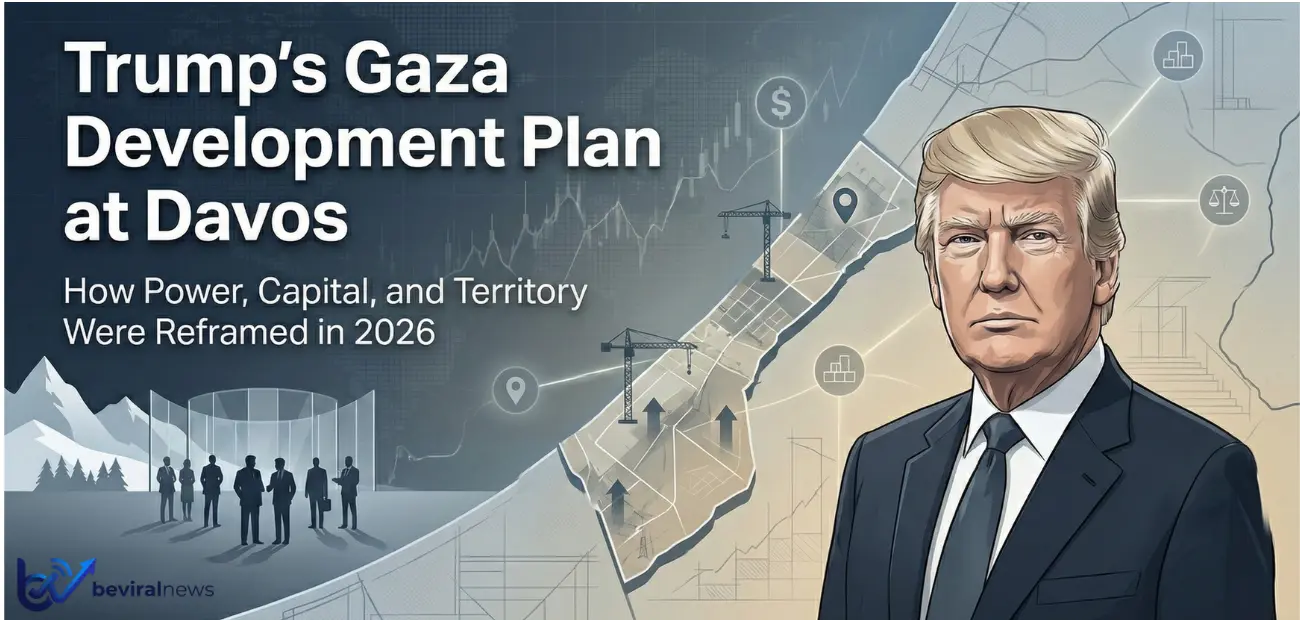
The Trump Gaza development plan revealed at Davos reframed Gaza less as a humanitarian crisis and more as a real estate and economic asset.
It signaled a shift toward market-led reconstruction tied to geopolitical leverage, not traditional aid.
In 2026, this matters because it reflects how power, capital, and territory are increasingly discussed in the same sentence.
Why This Matters
For years, Gaza discussions followed a predictable script: humanitarian aid, ceasefires, stalled peace talks.
That script no longer fits how global power brokers think.
At Davos, the language changed. Development, land value, private capital, and regional control entered the conversation in ways that unsettled diplomats and intrigued investors. Most public analysis either dismissed the comments as rhetoric or exaggerated them as policy certainty.
Both reactions miss the point.
This guide explains exactly what works, what doesn’t, and how to choose correctly.
How the Trump Gaza development plan surfaced at Davos
At the World Economic Forum, comments linked to Donald Trump and his allies reframed Gaza through economic redevelopment rather than political sovereignty. The setting mattered. Davos is where speculative ideas are tested before becoming policy narratives.
In real-world use, Davos speeches often function as signal events, not commitments. They reveal how influential actors want markets and governments to start thinking.
Key signal: Gaza was described less as a conflict zone and more as underutilized coastal territory.
That framing is not accidental.
Why real estate language in Gaza is not neutral
Calling Gaza a “development opportunity” shifts responsibility away from political resolution and toward capital deployment. This is where Middle East real estate geopolitics enters the discussion.
Most users notice this pattern elsewhere:
- Post-war Ukraine reconstruction discussions
- Port development in the Horn of Africa
- Energy corridors in the Eastern Mediterranean
The common mistake is assuming development talk equals peace planning. It doesn’t.
Recommendation: Interpret this language as power positioning, not humanitarian intent.
What the Gaza redevelopment proposal actually implies
The Gaza redevelopment proposal floated at Davos implied three core assumptions:
- External control precedes investment
- Private capital replaces international aid
- Economic normalization substitutes political resolution
Each assumption carries risk.
In real-world use, similar models have succeeded only when local governance legitimacy already existed. Gaza does not meet that condition in 2026.
Limitation: Without political sovereignty, redevelopment plans remain theoretical.
Trump Davos agenda: why timing matters in 2026
The Trump Davos agenda surfaced during a year of global fragmentation:
- Slowing global growth
- Investor fatigue with unstable regions
- Rising skepticism toward multilateral institutions like the World Economic Forum
In this context, bold statements attract attention even without policy backing.
Decision filter: This agenda is best understood as narrative positioning ahead of potential U.S. political shifts, not a finalized roadmap.
Who benefits from framing Gaza as an economic project
This framing benefits three groups:
- Speculative investors seeking frontier assets
- Regional powers wanting normalization without concessions
- Political actors reframing conflict as inefficiency
Who it does not benefit:
- Gaza’s civilian population without agency
- Diplomats seeking enforceable peace frameworks
A common mistake is assuming economic logic automatically improves living conditions. History suggests otherwise.
When economic development works — and when it doesn’t
When it works:
- Local governance controls land and law
- Security is internally enforced
- Capital aligns with labor and services
When it fails:
- Development is externally imposed
- Security depends on military presence
- Locals are treated as labor inputs, not stakeholders
The Gaza economic development plan currently fits more of the second category.
Why this approach appeals to U.S. audiences
For U.S., UK, AU, and EU professionals, the appeal is familiar:
development sounds pragmatic, non-ideological, and businesslike.
In real-world use, this mirrors how Silicon Valley discusses “fixing” cities—optimize first, resolve politics later.
Warning: That mindset often ignores historical power dynamics.
World Economic Forum Gaza remarks: signal, not strategy
The World Economic Forum Gaza remarks should be read as agenda testing.
Davos is where ideas are floated to measure:
- Media reaction
- Market curiosity
- Diplomatic resistance
Most never become policy.
Clear takeaway: The remarks reveal how elites are thinking, not what will happen next.
Common mistakes readers make when interpreting this plan
- Treating Davos comments as official policy
- Assuming development equals peace
- Ignoring who controls land and borders
- Overestimating private capital’s tolerance for instability
Avoiding these errors leads to clearer judgment.
Who should take this agenda seriously — and who shouldn’t
Should pay attention:
- Geopolitics students
- Policy analysts
- Global investors studying narrative shifts
Should be skeptical:
- Anyone expecting near-term change on the ground
- Those assuming humanitarian outcomes
This is a long-term framing exercise, not a 2026 action plan.
FAQs
Is the Trump Gaza development plan official U.S. policy?
No. It reflects political signaling, not an adopted government strategy.
Such ideas often test reactions before formal platforms exist.
Does this plan improve life for Gazans?
Not directly.
Without governance and sovereignty, development benefits rarely reach civilians.
Why discuss Gaza at Davos at all?
Davos is where economic narratives are shaped.
Raising Gaza there reframes it for investors, not voters.
Is this about real estate or geopolitics?
Both.
Real estate language is used to advance geopolitical positioning.
Could this plan realistically happen in 2026?
Highly unlikely.
Security, legal, and political barriers remain unresolved.
Final Takeaway
The Trump Gaza development plan revealed at Davos is less about rebuilding Gaza and more about redefining how power talks about conflict zones. It prioritizes capital, control, and optics over sovereignty and self-determination.
With a clear understanding of how this works, readers can now evaluate similar proposals with sharper judgment — without guesswork.