
Summary
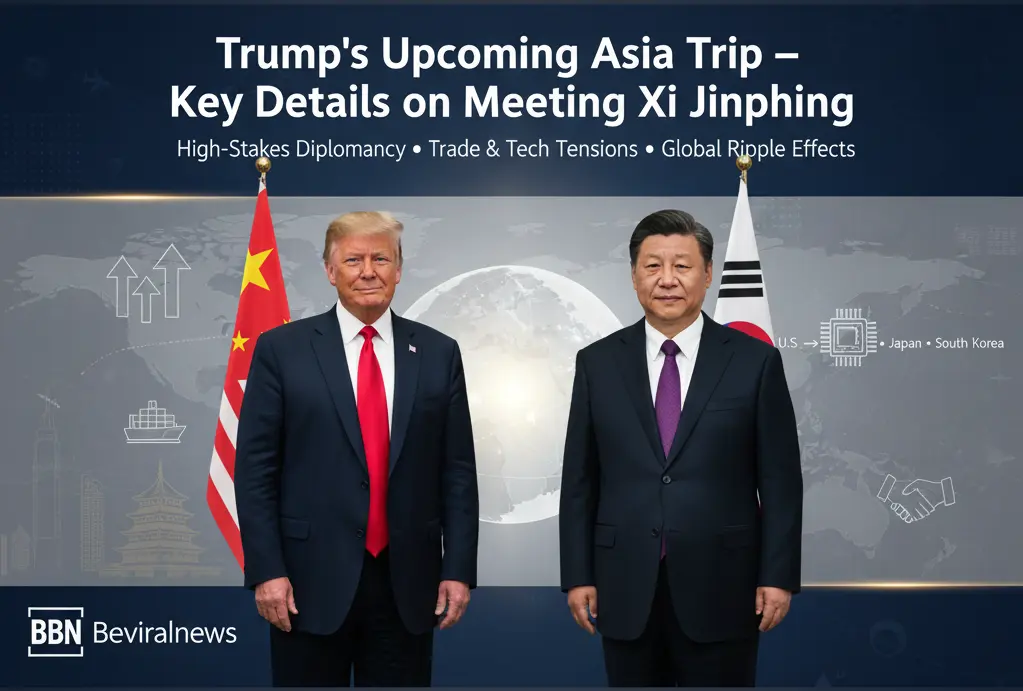
“Donald Trump’s upcoming Asia trip – centred on his high-stakes meeting with Xi Jinping – may seem complex, but with a clear focus and smart preparation you can grasp the key details simply and confidently.”
What’s the basic picture?
Let’s break this down for beginners:
Who, what, where, when, why
- The U.S. President Donald Trump is traveling to Asia, visiting multiple countries including Malaysia, Japan and South Korea.
- On this trip he plans to meet with Chinese President Xi Jinping.
- The meeting is scheduled to take place on the sidelines of the APEC summit in South Korea (reportedly in the city of Busan) sometime during the visit.
- The big themes: trade tensions between the U.S. and China, investment deals, possibly de-escalating parts of the U.S.–China relationship.
Why it matters
- The U.S. and China are two of the world’s largest economies and often clash on trade, technology, tariffs and geopolitical influence.
- A meeting between their leaders signals both the opportunity and the stakes: either a path toward cooperation or a flashpoint of conflict.
- For audiences (economies, investors, global trade watchers) this meeting has ripple effects: from supply-chains, rare-earths, to regional security.
So in short: One trip. High stakes. Multiple countries. Big partner (China). Big issues (trade, tech, geopolitics).
What are the advanced insights?
For readers who already know the broad strokes, let’s dig deeper into what’s really driving this trip and the meeting.
A. The backdrop of U.S.–China relations
- The U.S. has launched an investigation into China’s compliance with the “Phase One” trade deal and found only partial fulfilment.
- China meanwhile has implemented export controls on rare-earth magnets and other critical minerals – signalling it can use its supply-chain strength as leverage.
- The trade war risks re-escalating: The U.S. is threatening tariffs (even 100 %) on Chinese goods if certain conditions aren’t met.
B. The significance of the meeting location and timing
- Holding the meeting during the APEC summit in South Korea adds a regional dimension: it’s not just bilateral but interlinked with Asia-Pacific economic architecture.
- Because the trip also includes stops in Malaysia and Japan, Trump is juggling regional diplomacy plus the big China moment.
- Timing matters: With global supply-chains under stress (post-pandemic, war in Ukraine, tech competition) there’s urgent pressure to show results.
C. What both sides want (and fear)
U.S. goals may include:
- Getting China to increase purchases of U.S. agricultural products (soybeans etc) and invest in U.S. projects.
- Limiting Chinese access to U.S. advanced technology or critical supply-chains when it comes to national security.
- Making progress on regional issues like Taiwan, Hong Kong, and strategic balance in Asia.
China’s goals may include:
- Gaining relief or roll-back on U.S. tariffs.
- Securing access to advanced tech and asserting its role in Asia.
- Showing that it is not coerced, and can negotiate from a place of strength given its export-control tools.
Major fears:
- If the meeting goes poorly, trade could sour further, tariffs could escalate, supply chains could shift away from China.
- If it goes too favourably for one side, critics on the other side risk accusing their leader of conceding too much.
D. Real-life anecdote for context
Back in 2019, when Trump and Xi met at the G20 Osaka Summit, their handshake photo became symbolic of a turning moment—though ultimately the underlying tensions remained.
Similarly, this upcoming meeting may produce symbolic optics (a handshake, a shared statement) but the real work is in the details of what both sides agree/invest in.
How will this trip unfold? Step-by-step guide
Here’s a structured walkthrough of how the trip is expected to go, what to watch, and what each stage means.
| Step | Location & Event | What to look for |
| 1 | Depart from U.S. → Arrive Malaysia | Early stop; meeting with Malaysian PM, regional diplomacy ahead of China session. |
| 2 | Malaysia: ASEAN interactions | Signals how U.S. is engaging Southeast Asia, possibly as part of broader China strategy. |
| 3 | Japan stop | Reinforcement of U.S.–Japan ties, another Asian partner, setting stage for credibility in Asia. |
| 4 | South Korea: APEC Summit & Meeting with Xi Jinping | The headline moment: bilateral meeting inside broader multilateral gathering. |
| 5 | Post-meeting: Announcements, joint statements, side deals | Look for investment announcements, trade deal outlines, maybe even joint press conference. |
| 6 | Return & implementation phase | What matters here is not just photo-ops but follow-through: actual tariff changes, investment flows, verifiable actions. |
Key watching points
- Date/time of the Trump–Xi meeting: At present, while there is strong expectation, exact timing is still subject to confirmation.
- Agreed outcomes: Are there measurable trade commitments, investment pledges, or treaties of any kind?
- Tone and framing: Is the meeting framed as cooperative (“working together”) or confrontational (“we will impose tariffs”)?
- Regional ripple effects: How does this impact U.S. relations with Japan, South Korea, Southeast Asia? And how does China react to those?
Why this matters beyond just the photo-op
This trip is more than just a handshake—it could shape major sectors, economies and strategic alignments.
For trade and economy
- Global supply chains might shift: If China loses access to certain tech or resources, or if U.S. firms are incentivised to move their supply bases.
- Tariffs and import/export flows: U.S. farmers and manufacturers are stakeholders; China has leverage via large purchase commitments.
- Rare earths and critical minerals: China’s export controls here give it negotiation leverage.
For geopolitics & security
- Asia’s regional architecture: U.S. showing it belongs in Asia, not just Europe/Atlantic.
- China’s standing: Whether it can show leadership and influence or be boxed in.
- Secondary issues: Taiwan, Hong Kong, North Korea’s potential involvement (even if not directly on the agenda) are all shadows to this meeting.
For public perception & domestic politics
- Trump’s presidency: This trip is also about projecting global leadership, especially if he wants to show he can handle big foreign-policy deals.
- China’s domestic narrative: Being able to deal with the U.S. on equal footing is a matter of prestige.
- Media and investor confidence: Markets tend to react to signals from such meetings; uncertainty often spooks markets.
FAQs
What countries will Trump visit on his Asia trip?
He will visit Malaysia, Japan and South Korea as part of his Asia tour.
Will Trump meet Xi Jinping?
Yes, a meeting between President Trump and President Xi Jinping is expected during the trip, most likely on the sidelines of the APEC summit in South Korea.
What are the main issues on the agenda?
Key issues include:
- U.S.–China trade tensions and tariffs.
- Technology export controls and critical minerals.
- Agricultural trade (soybeans etc) and investment commitments.
Why is the trip important for Asia?
Because the U.S. is reaffirming its role in Asia, China is demonstrating its regional influence, and smaller Asian nations are listening closely to how these super-powers deal. The outcome may affect regional trade, security alignments and investment flows.
What could go wrong?
- Failure to reach concrete agreements could hurt both sides economically and politically.
- Escalation of tariffs if one side feels short-changed.
- Mixed signals: if the meeting appears weak or symbolic but lacks substance, critics may use it to say the U.S. or China gave up too much.
Conclusion
The upcoming trip of President Trump and his planned meeting with President Xi Jinping is a critical moment in global diplomacy. Understanding the intricacies—why it matters, how it unfolds, and what the stakes are—gives you a head-start in interpreting what comes out of it.
If you’re tracking global policy, investment trends, or regional dynamics in Asia, stay tuned: sign up for updates, follow trusted news outlets, and keep an eye on official statements following the meeting. This is one diplomatic event worth paying attention to.
👉 Action step: Subscribe to a reputable international relations newsletter or alert service so you’re first to hear any announced agreements or outcomes from this meeting—don’t miss the ripple effects.