
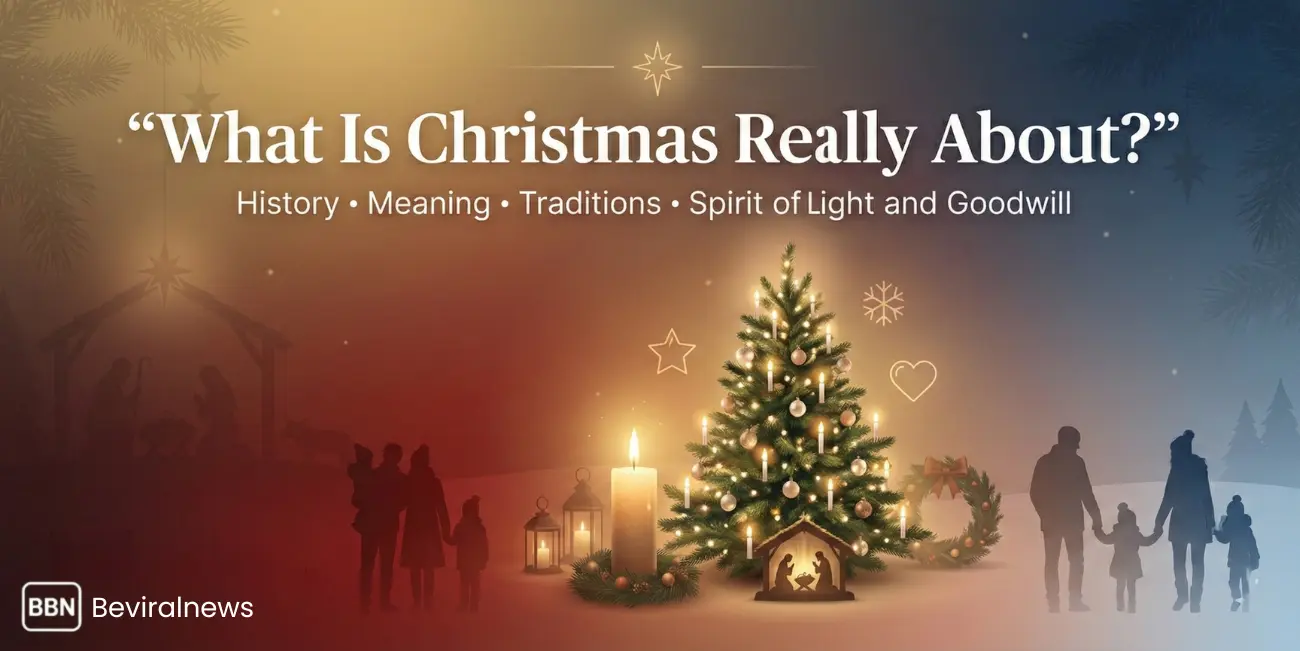
What Is Christmas Really About? Exploring Its Meaning, Traditions, and Spirit might sound simple — just a holiday on December 25 — but beneath the surface lies a rich tapestry of history, faith, culture, and deeply personal meaning. With the right understanding, you can reconnect with what makes Christmas powerful — and most people don’t even realize how easy it is to tap into that deeper significance.
The Real Story Behind Christmas
The Birth of an Idea — Where Christmas Comes From
Imagine a time when the deepest nights of winter gave way to longer, brighter days. Long before modern holidays, many ancient cultures marked this shift — they celebrated the return of light, hope, and renewal.
When hristians began commemorating the birth of Jesus (peace be upon him), they chose December 25 for that celebration — not because original scriptures specify that date, but likely because that time overlapped with existing winter-festivals and the symbolic celebration of rebirth.
That official designation goes back to early centuries of the Church.
In naming the holiday “Christmas” (from “Christ’s Mass”), early Christians tied the celebration directly to the birth of Christ.
So Christmas, at its origin, is both an act of faith and a deliberate merging of newer religious meaning with older human traditions of winter-time warmth, light, and community.
Why December 25? The Calendar, the Church, and the Mystery
Two Main Theories — Light or Liturgical Logic
- Synching with the Light: December 25 may have been chosen because it’s close to the winter solstice — the darkest time of the year — symbolizing the coming of “light” to the world.
- Liturgical Reasoning: Another idea is that some early Church scholars placed Jesus’ conception on March 25 (a date sometimes associated with creation or “annunciation”), then counted nine months forward to arrive at December 25 for his birth.
The truth? The historic record doesn’t definitively confirm either theory. The choice of December 25 remains partly symbolic — intended to align Christian faith with existing cultural rhythms and seasonal symbolism, while offering a new meaning.
This uncertainty speaks to the blend of faith, culture, and human interpretation at Christmas’ heart.
How Christmas Evolved — From Church to Culture
From Sacred Feast to Global Holiday
Originally, Christmas was a liturgical celebration centered around the birth of Christ. Over centuries, it grew in popularity. By the Middle Ages, Christian worship was joined by feasting and festivity.
But by the 19th and 20th centuries — especially in Western countries — Christmas became as much cultural and secular as it was religious. Traditions such as decorating evergreen trees, exchanging gifts, sending greeting cards, and waiting for a figure known as Santa Claus began blending with religious observance.
Today, many people who celebrate Christmas may not even focus on the religious aspects — instead, they enjoy time with family, giving gifts, festive meals, lights, decorations, and the seasonal joy of togetherness.
This dual nature is perfectly normal: Christmas can be both sacred and secular, spiritual and social — sometimes all at once.
What Christmas Means — Beyond the Date
At Its Core: Light, Hope, and Goodwill
- Hope in darkness: Celebrating the birth of Christ amid winter’s darkness can symbolize hope — light returning, new life, renewal.
- Generosity and giving: Gift-giving echoes the traditional story of wise men bringing gifts to baby Jesus — but also taps into the human instinct to care, share, and connect.
- Family and community: Historically and today, Christmas is often about gathering, bonding, and reconnecting. It’s a time to pause, reflect, and value relationships over routine.
- Joy, wonder, and ritual: Traditions — whether religious (midnight mass, nativity scenes) or secular (decorations, songs, lights) — add rhythm, comfort, and shared memory to human life.
In short: Christmas offers a chance to re-center on what matters — values, relationships, warmth — not just gifts or parties.
Traditions That Shaped Christmas — And What They Symbolize
Evergreen Trees, Lights & Symbols of Life
Decorating evergreen trees dates back many centuries. Fir trees — symbols of life in winter — were brought indoors and adorned, often with candles (later electric lights), ornaments, and fruit.
This symbol of life in dormancy — the evergreen — resonates especially in winter, when nature seems bare but life persists.
Gift-Giving: From Magi to Modern Mystique
Gift-giving links back to the gifts offered to Jesus by the Magi, but also to ancient winter festivals where sharing food and wealth was common. Over time, exchanging gifts became a way to show love, gratitude, and hope.
Songs, Carols, and Community Voices
Singing carols, telling stories, and gathering around light were — and remain — ways to build community, share values, and mark the holiday’s emotion beyond the tangible.
Blending Pagan Hope and Christian Faith — A Historical Patchwork
Some Christmas customs echo older pagan or pre-Christian winter-solstice celebrations (celebrating light, rebirth, greenery). Overlays of Christian meaning (birth of Jesus, hope, salvation) created a hybrid holiday that resonates across faiths and cultures.
In essence: Christmas is not a fixed, monolithic tradition. It’s evolving — like culture — with each generation adding layers of meaning.
Islamic Perspective: Why Many Muslims Do Not Celebrate Christmas
If you follow Islam, here’s how you might view Christmas — and why many Muslims avoid participating in it as a religious holiday.
Theological Foundations: Oneness of God (Tawḥīd) & Role of Prophets
Islam centers on the belief in the absolute oneness of God (Tawḥīd). In that light, Jesus (ʿĪsā) (peace be upon him) is respected as a prophet and messenger of Allah, not as divine or the “Son of God.”
Because Christmas as a holiday celebrates the birth of Jesus in a Christian theological framework that often implies divinity or “Son of God” doctrines, many Islamic scholars view participating in Christmas celebrations as incompatible with Islamic beliefs.
Concern About Imitation (Tashabbuh) and Religious Identity
There is a well-known principle in Islamic jurisprudence cautioning Muslims against imitating religious practices unique to non-Muslims (especially when those practices are tied to beliefs contrary to Islam).
According to this view, celebrating Christmas — especially with decorations, gift-giving tied to religious symbolism, attending church services, or saying “Merry Christmas” as part of religious endorsement — could be seen as adopting non-Islamic religious customs.
Why Islamic Holidays Are Different
For Muslims, religious festivals are those established or sanctioned by scripture and prophetic tradition — such as Eid al-Fitr and Eid al-Adha. These are tied to acts of worship, remembrance of Allah, gratitude, and specific events/historical acts. Celebrating a prophet’s birthday — including that of Jesus or the final prophet Muhammad — is not part of that tradition.
From this perspective, Christmas is not recognized as a valid Islamic festival; instead, it remains a Christian religious observance outside the framework of Islamic worship.
Respect for Others — But Maintaining One’s Beliefs
That said — Islam teaches respect, kindness, and peaceful coexistence with people of other faiths. Many scholars note there’s a difference between respecting someone’s festival and participating in it as a religious observer.
So while celebrating Christmas (with full religious or ritual participation) is often considered impermissible (ḥarām) by mainstream Islamic scholarship, living peacefully alongside Christians, respecting their beliefs, and interacting with them kindly remains consistent with Islamic values.
In that sense: a Muslim can hold to his faith while still treating friends or neighbors with respect — without necessarily endorsing the beliefs behind the holiday.
What Christmas Means (or Could Mean) — Even Through an Islamic Lens
Even if many Muslims don’t celebrate Christmas, some of the values associated with the season can resonate positively with Islamic ethics — as long as the theological boundaries are understood.
- Generosity, charity, kindness: Islam emphasizes good deeds, helping the needy, and generosity — these values overlap with the “gift-giving and goodwill” spirit many associate with Christmas.
- Family, community, togetherness: The idea of using holidays to gather, reconnect, and strengthen social bonds is universal and aligns with Islamic emphasis on family and community ties.
- Respect and coexistence: In multi-faith societies or multicultural contexts, understanding and respect for other people’s celebrations (without compromising one’s own faith) nurtures harmony, which Islam supports.
- Peace, goodwill, unity: The themes of peace, hope, and goodwill — often celebrated during Christmas — can align with the broader human values encouraged by Islam.
Viewed this way, one might recognize Christmas as a cultural season for many, and appreciate certain values — not as a religious celebration, but as part of human solidarity and compassion.
Navigating Reality — What Muslims Living in a Diverse World Often Do
In a multicultural or interfaith environment, many Muslims find themselves surrounded by Christmas celebrations. How do they respond?
- Some choose to respect the holiday socially without participating in its religious aspects — e.g., allowing children to attend school parties, sharing treats, or being cordial with Christian friends.
- Some avoid all Christmas-related rituals, out of conviction that participating amounts to imitation or religious compromise.
- Others may separate “cultural holiday spirit” (lights, winter-season fun, charity) from religious meaning — enjoying the goodwill, human kindness, and social warmth — while maintaining their faith identity.
This diversity of responses reflects a balance between faith, personal conviction, and coexistence — a reminder that human experience is rarely black-and-white.
How to Understand Christmas — If You’re Muslim or Respect Islamic Beliefs
If you follow Islam — or simply want to approach Christmas thoughtfully while respecting your beliefs — here’s a gentle, realistic way to think about it:
- Remember your core belief: Tawḥīd — the Oneness of God. That’s central to Islam, and any religious celebration should align with that.
- Know the difference between cultural vs religious practices. Appreciating goodwill, charity, family time — those are human values, not exclusive to any faith.
- Respect others — but be clear about your boundaries. It’s okay to treat non-Muslim friends with kindness and respect, even if you don’t share their religious celebrations.
- Celebrate what’s meaningful in your faith. Participate in your own festivals (like Eid), acts of charity, remembrance of Allah, family — those give spiritual fulfillment while preserving your identity.
- Seek knowledge and understanding. When uncertain, ask trusted scholars or look into teachings — making informed choices helps you stay firm and respectful.
Frequently Asked Questions
Q: Why don’t many Muslims celebrate Christmas even though Islam honours Jesus (ʿĪsā)?
Because in Islam, Jesus is regarded as a noble prophet — not divine or the “Son of God.” Celebrating his birthday (or Christmas) as a religious holiday is viewed by many scholars as conflicting with the Islamic belief in the oneness of God (Tawḥīd) and the prohibition against imitating non-Muslim religious festivals.
Q: Is wishing “Merry Christmas” haram for Muslims?
Many scholars discourage Muslims from saying “Merry Christmas,” if the greeting is meant as religious approval or endorsement. Saying it may imply acceptance of beliefs inconsistent with Islamic monotheism. Others argue that neutral greetings like “Happy Holidays” or a polite “season’s greetings” may be more appropriate in multicultural contexts — as social courtesy rather than religious affirmation.
Q: Can Muslims participate in the “cultural” aspects of Christmas (lights, decorations, gifts) without sin?
Mainstream scholars generally view classical religious rituals or distinct Christian religious aspects (church attendance, religious symbolism) as impermissible. But in some contexts, social interaction — such as being kind to neighbors or accepting gifts without religious endorsement — may be acceptable, as long as no religious endorsement or belief in Christian theology is implied.
Q: Does Islam have its own equivalent holiday or way to honour prophets like Jesus?
Yes — Muslims have their own religious celebrations rooted in Islamic tradition: chiefly, Eid al-Fitr and Eid al-Adha. These mark significant spiritual events (end of Ramadan, sacrifice of Prophet Ibrahim) — but birthdays of prophets (including Jesus or Muhammad) are not part of official Islamic festivals.
Q: Is there any harm in Muslims living in predominantly Christian societies letting their children enjoy seasonal fun?
It depends on intention and awareness. If the intention remains within the bounds of one’s faith — not embracing Christian theology — and the family maintains Islamic identity, some scholars allow social interaction and cordial participation under “respect and coexistence.” But if celebrations begin to blur religious boundaries, concern arises.
A Balanced View — Christmas, Faith, and Shared Humanity
Christmas began as a Christian commemoration of Jesus’ birth. Over centuries, it has grown into something far broader — a time to mark light in darkness, to reconnect with loved ones, to give, to hope, and to believe in renewal.
From an Islamic perspective, though, the religious foundations of Christmas — especially beliefs about Jesus’ divinity — conflict with the core principle of Tawḥīd. Because of that, mainstream Islamic teaching does not permit Muslims to celebrate Christmas as a religious holiday.
Yet many of the holiday’s secular values — kindness, generosity, community, compassion — align with universal human and Islamic ethics. Recognizing that doesn’t require compromising one’s faith — it simply means acknowledging what’s good and human.
For Muslims living in a diverse, multi-faith world: it’s possible to respect others, live peacefully, and hold to one’s beliefs — without judgment but with clarity and integrity.
So this year: if you see Christmas lights or hear “Happy Holidays,” you don’t have to feel torn. Recognize the cultural atmosphere, appreciate kindness and goodwill, but stay grounded in your own beliefs.
Because in the end — what matters is sincerity, faith, and respect — for yourself and for others.
Take a moment. Reflect on your values and what brings you closer to faith, family, and humanity. Then move forward with clarity and peace.